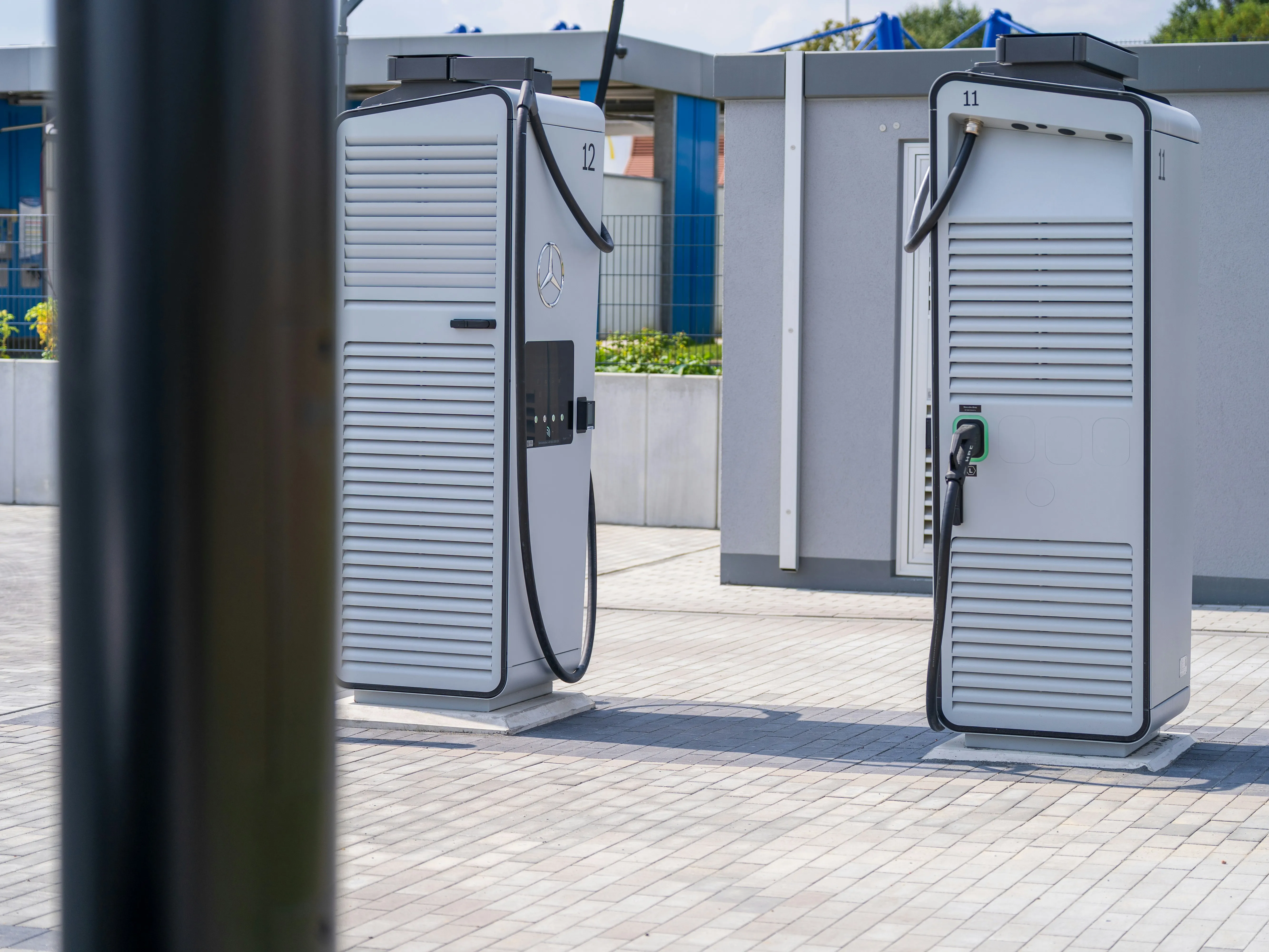
Connectivity for the EV Charging Sector
The UK is in the middle of a significant public charging rollout. Tens of thousands of new charge points are being installed annually, the regulatory framework around reliability and payment is tightening, and end-users expect the charging experience to be as simple as filling up a petrol tank. Underneath all of this, the connectivity layer is what makes charging work or fail.
Millbeck provides the cellular connectivity that charge point operators, charge point manufacturers, and EV charging software providers rely on to keep their networks online. From single-site operators to national charging networks, we supply the multi-network IoT SIMs, security architecture, and management tools that turn compliance requirements into operational reality.
How Does Millbeck Connect EV Charging Points?
Millbeck supplies multi-network IoT SIMs, eSIM and eUICC SIMs, private APN services, and industrial routers for EV charging networks across the UK and internationally. Our capabilities support the requirements of the UK Public Charging, including the 99% reliability target for rapid chargers, contactless payment connectivity, and OCPI data publishing.
The UK Public Charge Point Regulations and What They Mean for Your Connectivity
The Public Charge Point Regulations 2023, now fully in force since 24 November 2024, have reset the operational bar for UK charge point operators. The regulations require a 99% reliability average across rapid (50kW+) charge point networks, mandatory contactless payment on 8kW+ new chargers and 50kW+ existing chargers, a 24/7 staffed helpline, and annual reporting to the Office for Product Safety and Standards. Non-compliance penalties reach £10,000 per charge point.
Reliability and payment are directly dependent on cellular connectivity. A charger that can’t reach the CSMS via its SIM can’t report availability, can’t start a session, can’t process payment, and can’t contribute to the reliability metric. Connectivity failure is compliance failure.
This page covers how Millbeck supports charge point operators, charge point manufacturers, and software providers in meeting the regulatory bar and running charge points that work reliably for drivers.
Keeping Charge Points Online, Connectivity for 99% Reliability
The reliability requirement is the biggest operational pressure on UK charge point operators today. A rapid charger that reports as unavailable or unknown counts against the 99% target. Connectivity outages are a major contributor to those status reports.
Multi-network IoT SIMs. Millbeck’s multi-network SIMs connect to whichever UK carrier has the strongest signal at each charger’s location, automatically switching if the primary carrier has an outage or degrades. For a motorway service station, this might mean EE working reliably in one bay and O2 working better in another. The SIM handles the choice without intervention.
Coverage in challenging locations. Charge points are installed everywhere: urban car parks with RF interference, rural sites at the edge of cellular coverage, underground parking with poor signal, motorway laybys, and service station forecourts. Single-carrier SIMs fail inconsistently across these environments. Multi-network SIMs reduce that variability significantly.
Proactive visibility. Our SIM management platform flags connectivity issues before they cause visible reliability impact, letting operators respond to signal degradation or usage anomalies before a driver arrives at a non-functioning charger and contributes to a negative customer experience.
Contactless Payment Connectivity
The payment requirement in the regulations is binary: either a driver can use a contactless card or phone to start a charging session, or the operator is non-compliant. And contactless payments depend on a live connection to the payment processor.
Private APN for payment traffic. Millbeck provides private APN services that keep card payment data off the public internet, routed instead through a dedicated, isolated network path to your payment processor. This supports PCI DSS compliance obligations and reduces the exposure of sensitive payment data.
Fixed IP addressing. Payment integrations often require fixed IP addresses for whitelisting in the payment processor’s firewall. We provide fixed private IP and fixed public IP options depending on the integration pattern your payment provider requires.
VPN tunnels. For operators routing payment data into a managed backend, IPsec or SSL VPN tunnels provide encrypted transport between the charger and your environment.
Data traffic filtering. Our SIM policies can restrict each charge point’s SIM to communicating only with approved endpoints (your CSMS, your payment processor, and nothing else). This prevents data exfiltration, blocks unauthorised endpoint access, and gives your security team a clean audit trail.
Cost Control and SIM Management at Scale
Running a national charge point network means managing thousands of SIMs across sites with wildly different usage patterns. Rapid chargers with high-volume OCPP messaging sit alongside slow chargers that barely generate any data traffic. Getting the commercial model right matters.
Pooled data plans. We offer pooled data plans that aggregate allowances across your estate, so high-usage chargers can use capacity that lower-usage chargers don’t need. This removes the need to size each SIM’s plan individually and makes total data cost more predictable as the network scales.
Instant provisioning controls. Activate, suspend, or terminate SIMs remotely via our management platform. When a charger is decommissioned or moved, its SIM can be suspended immediately to avoid billing costs on disconnected hardware.
Usage visibility. The platform tracks every SIM’s data usage, network performance, and alerts for anomalies. This supports both operational diagnostics and commercial reconciliation.
Security features for scale. IMEI lock binds each SIM to specific charge point hardware, preventing SIM theft and unauthorised device use. Voice barring removes voice capability from SIMs that should never need it. SMS filtering controls which systems can send or receive SMS with your chargers. Together, these close off the common misuse patterns that plague unmanaged IoT SIM estates.
Support for Charge Point Manufacturers (CPMs)
Charge point manufacturers face a specific set of connectivity challenges: ship hardware that works reliably in the field, support customers across multiple markets, and keep the commercial model simple enough to integrate into your factory build and sales process.
One SIM, one APN, multiple markets. For CPMs shipping into the UK, Europe, and beyond, a single eSIM or eUICC profile with our global IoT SIM service removes the need to manage per-market SIM variants in the bill of materials. Hardware ships with connectivity that works from day one, wherever it’s installed.
Factory provisioning. Pre-provisioned SIMs simplify factory build processes. Charge points arrive on site ready to connect, without requiring field engineers to swap SIMs or reconfigure APNs.
Real-time alerts. Our management platform gives your field service teams proactive visibility into every charge point’s connectivity status, supporting faster diagnostics and rapid field recovery when something goes wrong.
Hardware-aware security. IMEI lock prevents SIMs being moved between devices, reducing the risk of field tampering or commercial fraud across your estate.
Support for Charge Point Operators and CSMS Platforms
Charge point operators and CSMS (Charging Station Management System) platforms need connectivity that delivers consistent OCPP messaging, clean data paths, and predictable performance across every site in the network.
Dependable OCPP transport. Multi-network SIMs with low-latency routing support the OCPP messaging that underpins every session: authorisation, start, status reporting, metering, and session close. Messaging failures translate directly to failed sessions and unhappy drivers.
Private network architecture. Private APN, fixed IP, and VPN support give CSMS platform operators a secure, predictable connectivity pattern for integrating thousands of chargers into their backend. One architecture, repeatable across every customer and every site.
Open data compliance. The regulations require operators to publish charge point availability data using the OCPI protocol. Reliable connectivity is the foundation of accurate OCPI data, because availability can only be reported correctly when the charger can actually reach the backend.
What an EV Charging Connectivity Deployment Typically Includes
A complete Millbeck connectivity package for EV charging usually includes four elements.
Multi-network IoT SIMs (physical, eSIM, or eUICC variants), configured to the operator’s preferred APN and security architecture.
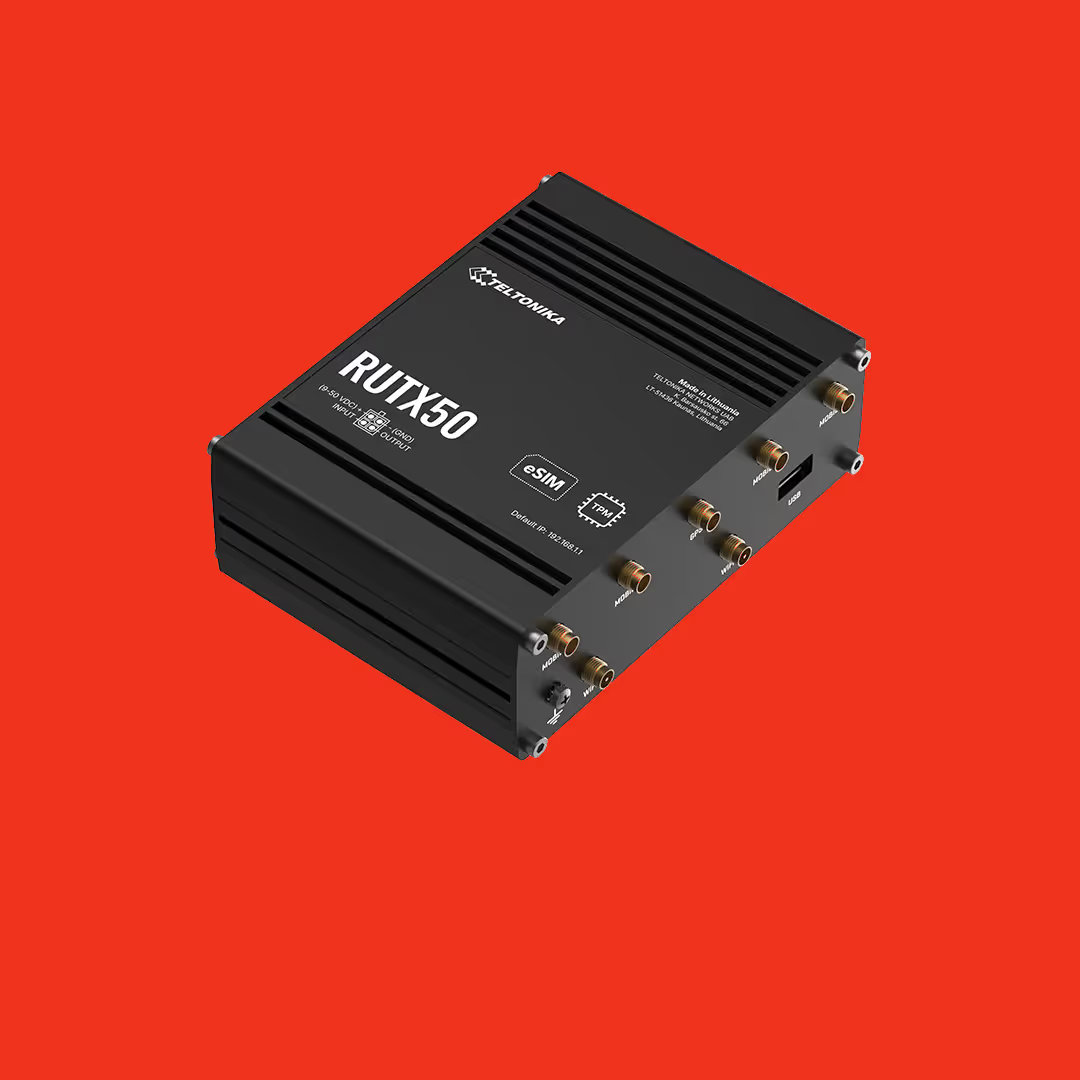
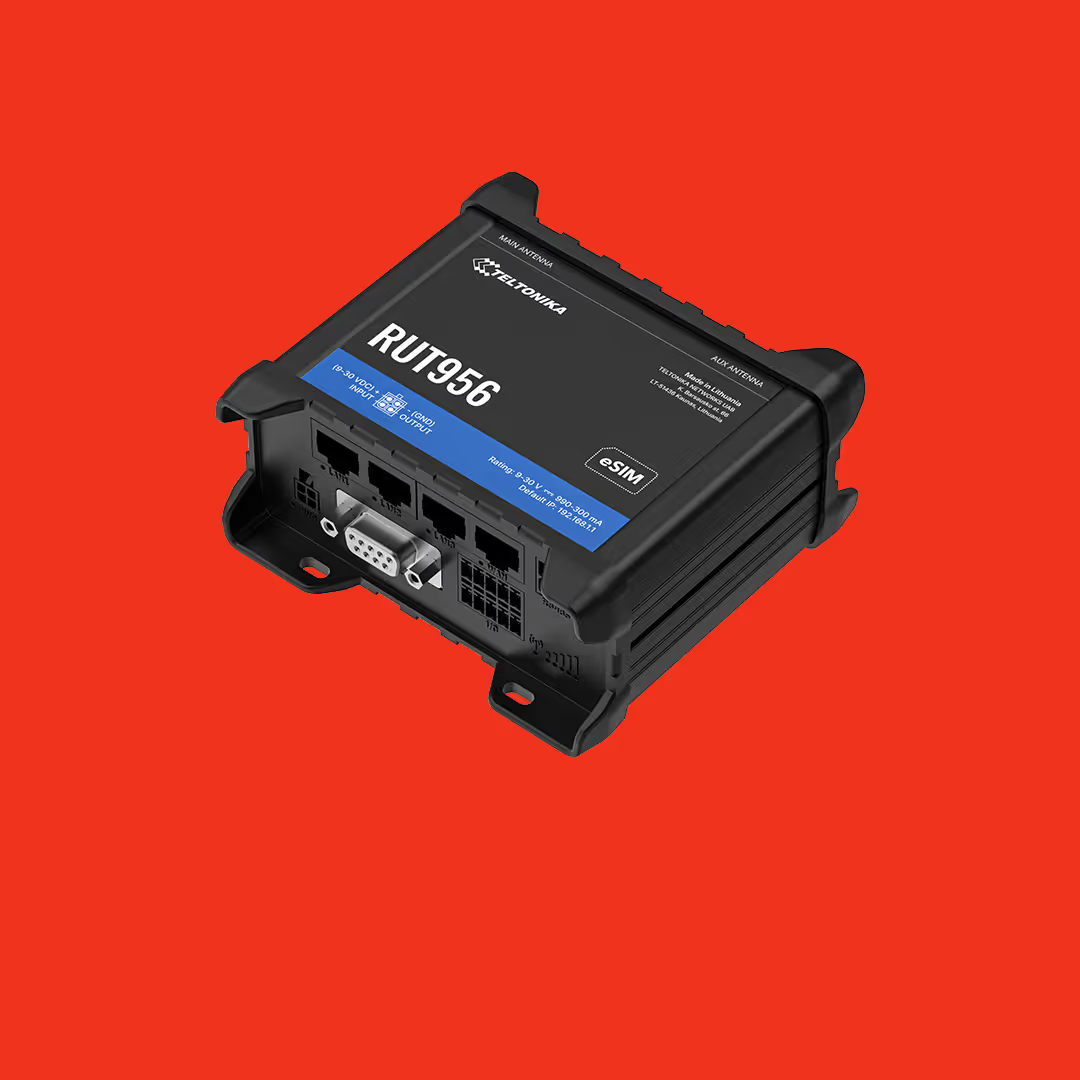
Teltonika industrial routers where a standalone router is needed, selected for charge point environments: outdoor cabinets, IP-rated enclosures, wide operating temperature ranges, and dual-SIM or cellular-plus-ethernet failover options.
Antennas from partners including Panorama, Poynting, Fullband, and 2J, selected for the cellular bands, the installation geometry, and the specific RF conditions of each charger’s location.
The SIM management platform, providing centralised visibility, policy management, usage tracking, and security features across the whole estate.
Frequently Asked Questions
What Are the UK Public Charge Point Regulations 2023?
The UK Public Charge Point Regulations 2023 came into force on 24 November 2023, with compliance deadlines through to 24 November 2024. The regulations require contactless payment on 8kW+ new chargers and 50kW+ existing rapid chargers, 99% reliability across rapid charger networks, a 24/7 staffed helpline, annual reliability reporting, and open data publishing via OCPI. Non-compliance fines reach £10,000 per charge point, enforced by the Office for Product Safety and Standards.
What Connectivity Does the 99% Reliability Requirement Need?
The 99% reliability target requires rapid charge points to be available, reserved, charging, or exempt for 99% of each reporting year. Connectivity outages that prevent a charger reporting its status contribute to non-compliance. Multi-network IoT SIMs, which automatically switch between carriers to avoid single-carrier outages, are the standard approach to protecting the reliability metric.
How Does Cellular Connectivity Support Contactless Payments?
Contactless card payments require a live connection between the payment terminal at the charge point and the payment processor’s backend. Millbeck’s private APN and fixed IP services provide a secure, isolated connection for this payment traffic, supporting PCI DSS compliance requirements and reducing the risk of payment data exposure.
What Is OCPP and Why Does It Matter for EV Charging Connectivity?
OCPP (Open Charge Point Protocol) is the industry-standard protocol for communication between charge points and backend management systems (CSMS). Every significant action on a charger (authorisation, start session, meter reading, stop session, status update) goes over OCPP. Reliable cellular connectivity is essential because an OCPP messaging failure generally means a session failure visible to the driver.
What Is the Difference Between eSIM and eUICC for EV Charging?
eSIM (embedded SIM) is a SIM soldered into the charge point hardware rather than inserted as a removable card. eUICC is the capability that allows an eSIM (or physical SIM) to hold multiple operator profiles and switch between them remotely. For charge point manufacturers, eUICC means one hardware SKU can be deployed across multiple markets and updated remotely as operator agreements evolve, without field SIM swaps.
Can Millbeck Support International EV Charging Deployments?
Yes. Our global IoT SIMs, eSIM, and eUICC variants cover networks across the UK, Europe, and beyond. The same SIM management platform works across country boundaries, giving charge point operators and manufacturers centralised visibility and management whether the deployment is UK-only or international.
Does Millbeck Supply Hardware as Well as SIMs for EV Charging?
Yes. Alongside our IoT SIMs, we supply Teltonika industrial routers and cellular modules suitable for EV charging environments, plus antennas from partners including Panorama, Poynting, Fullband, and 2J. As a Teltonika Diamond distributor, we can match the right hardware to the specific charge point deployment, whether that’s a compact router for integration into the charger itself or a standalone backhaul router for a site-level connectivity point.
This is some text inside of a div block.


.png)











.avif)
.png)
.png)