Industrial Antennas From Poynting
Poynting Antennas is a global antenna designer and manufacturer headquartered in Centurion, South Africa, with deep specialism in cellular, Wi-Fi, and mission-critical wireless communications. Their products are deployed across mining, marine, transport, public safety, telecommunications, smart cities, and industrial IoT in over 100 countries. The company has built its reputation on antennas engineered for environments where standard commercial antennas fail.
Millbeck supplies the full Poynting Antennas range, holding stock for fast UK delivery and providing technical guidance to match the right antenna to each deployment. Like all antenna selection, getting the Poynting choice right depends on understanding the deployment environment, frequency requirements, and physical mounting constraints, areas where Millbeck’s pre-sales support adds direct value.
In short: Millbeck stocks and supports the Poynting Antenna range, including the XPOL series of cross-polarised cellular MIMO antennas (the flagship range, with current generations XPOL-1-5G+ and XPOL-2-5G), OMNI series omnidirectional antennas (including marine variants), MIMO series transport and multi-function antennas, LPDA directional antennas for fixed-site high-gain applications, HELI series for mining and tunnel deployments, and specialist rugged antennas. Coverage spans 4G LTE, 5G NR, Wi-Fi 6E, GPS/GNSS, and CBRS frequencies.
The Poynting Product Range
Poynting’s portfolio covers the full breadth of industrial antenna requirements, from compact omnidirectional antennas for branch connectivity to high-gain directional antennas for cell-edge fixed wireless access.
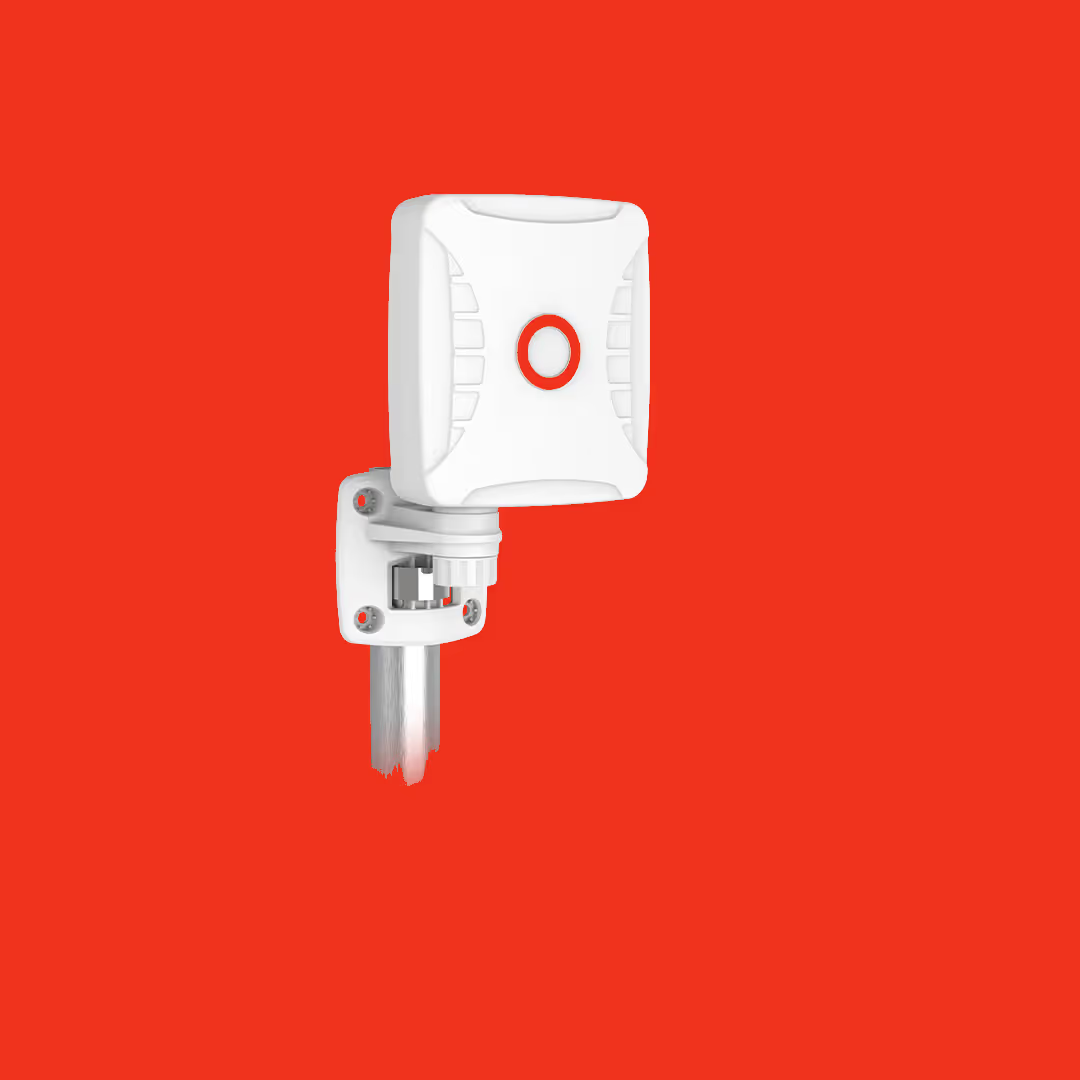
XPOL series cross-polarised cellular antennas. The flagship Poynting range, using cross-polarised dual-element design for MIMO performance. The XPOL-1-5G+ is the current third-generation omnidirectional antenna, supporting 410-6000MHz with 2×2 or 4×4 MIMO configurations and peak gain up to 7dBi. The XPOL-2-5G is the directional variant of the third generation, using Artificial Magnetic Conductor (AMC) metamaterial technology and a patent-pending radiator design for enhanced gain and bandwidth performance.
OMNI series omnidirectional antennas. Wideband omnidirectional cellular and Wi-Fi antennas for 360-degree coverage. The OMNI-280 covers 617-3800MHz for general LTE and 5G applications. The OMNI-291 and OMNI-400 are marine-grade variants for coastal and offshore deployments. The OMNI-294 and OMNI-296-V2 provide dual-band Wi-Fi coverage including the 2.4GHz, 5GHz, and 6GHz bands. The OMNI-297 (Rhyno) is the rugged variant for environments requiring additional mechanical resilience.
MIMO series transport and combination antennas. Multi-function antennas combining MIMO cellular with Wi-Fi and GPS in single housings, suited to vehicle and transport applications. Models such as MIMO-3-15, MIMO-4-15, MIMO-3-17, and MIMO-4-19 offer different combinations of cellular MIMO (2×2 or 4×4), Wi-Fi MIMO, and GNSS positioning depending on the deployment requirement.
LPDA directional antennas. Log-periodic dipole array antennas for high-gain directional applications. The LPDA-92 and LPDA-500 cover wide frequency ranges (LPDA-500 supports 617-7200MHz) for fixed wireless access, point-to-point links, and cell-edge boost applications where direction-aware gain is critical.
HELI series mining and tunnel antennas. Specialist antennas engineered for mining, tunnel, and underground deployments where standard antennas cannot deliver reliable coverage. Bi-directional designs and form factors specific to confined environments distinguish the HELI range from general-purpose products.
Specialist and custom variants. Rhyno rugged variants, marine-specific antennas, custom variants for defence and government applications, and specialised products for specific industrial sectors complete the Poynting range. Millbeck can source any specific Poynting product to order alongside the stock items.
Poynting’s Engineering Differentiation
Poynting is recognised in the antenna industry for technology-led differentiation rather than commodity competition. Three areas of engineering distinguish the product range.
Cross-polarised MIMO design. The XPOL series uses a dual-polarisation architecture (one antenna element vertically polarised, one horizontally polarised) within a single enclosure. This delivers the diversity gain that MIMO modems exploit, while keeping the physical antenna footprint compact. For most cellular deployments the cross-polarised approach gives better real-world performance than two co-polarised antennas would.
Artificial Magnetic Conductor (AMC) metamaterial. The latest XPOL-2-5G generation incorporates AMC structures alongside a patent-pending radiator design. AMC is a metamaterial technique that improves antenna efficiency and bandwidth by manipulating the electromagnetic environment around the radiating element. The practical effect is higher gain and wider frequency coverage in the same physical envelope as previous generations.
Consistent radiation patterns across bands. A common limitation in lower-cost cellular antennas is unstable radiation patterns that vary significantly between frequency bands, causing connection instability as modems switch between bands or cell sites. Poynting’s design philosophy emphasises pattern consistency across the supported frequency range, supporting stable cellular connections in real-world deployment conditions.
Frequency Coverage and 5G Readiness
The current Poynting generation is engineered specifically for 5G NR, Wi-Fi 6E, and the emerging frequencies operators are deploying.
The XPOL-1-5G+ supports 410-6000MHz, one of the widest cellular frequency ranges available across any commercial antenna. This covers all 5G NR sub-6GHz allocations, all 4G LTE bands including the 700MHz and 600MHz Band 71 used in the UK and US respectively, and provides forward compatibility for spectrum that operators may repurpose over the deployment life. For long-life infrastructure installations where antenna replacement is operationally expensive, this matters.
Wi-Fi coverage on dedicated Wi-Fi products extends through 2.4GHz, 5GHz, and the 6GHz Wi-Fi 6E band, with selected products supporting CBRS (Citizens Broadband Radio Service) bands relevant to private network deployments.
For specific frequency requirements (specific 5G mid-band allocations, defence-specific frequencies, marine VHF/UHF), Millbeck can confirm exact frequency coverage on each Poynting product against the deployment specification.
Environmental Resilience and Industrial Certifications
Poynting designs for outdoor and industrial deployment as standard, not as a premium variant.
IP65 environmental rating across the standard range. Most Poynting products carry IP65 (dust-tight, protection against water jets), suitable for outdoor mounted installations and the routine environmental exposure of industrial sites. Specialist marine and rugged variants carry higher ratings appropriate to their deployment environment.
UV stability and material durability. Outdoor antennas use UV-stable polymers and corrosion-resistant materials engineered for long operational life in direct sunlight, saltwater exposure, and temperature extremes. The marine OMNI series in particular is designed for coastal and offshore deployment where standard outdoor antennas would degrade rapidly.
Mounting and mechanical resilience. Pole, wall, magnetic, and window mounting options across different products. Mechanical designs accommodate installation in environments with vibration, mechanical stress, and routine handling that would damage less rugged products.
For deployments with specific environmental certifications required (defence specifications, hazardous area, specific marine certifications), Millbeck can confirm the certification status of each Poynting product against the deployment requirement.
Combining Poynting Antennas With the Connectivity Stack
Antennas only deliver their performance when matched to the rest of the connectivity stack: router, SIM, cabling, mounting, and the physical environment.
Millbeck’s value as a Poynting partner is in the integration. We pair Poynting antennas with industrial routers and gateways from across our hardware portfolio, with Millbeck IoT SIMs (UK roaming, global roaming, eSIM, or eUICC), and with the cabling and mounting hardware required for each deployment. We confirm cable specifications, connector types, and grounding requirements at the design stage, and pre-test compatibility for high-stakes deployments.
For the buyer, this means one supplier across the connectivity layer with technical accountability across the stack, fast UK delivery, and a single relationship for procurement, installation, and operational life.
Where Poynting Antennas Are Used
Common Poynting deployment scenarios include:
Fixed wireless access and cellular broadband. XPOL series and LPDA antennas for households, businesses, and public sector sites using cellular as primary or backup connectivity. Strong fit for rural fixed wireless access where line-of-sight to the cell tower benefits from directional antennas.
Mining and tunnel applications. HELI series and specialist rugged antennas for underground mining, road tunnels, and confined-space deployments where standard cellular antennas cannot deliver reliable coverage.
Marine and coastal deployments. OMNI marine series for coastal monitoring, offshore platforms, vessel connectivity, and coastal infrastructure. Saltwater corrosion resistance and the radiation pattern requirements of marine deployment differentiate these products.
Transport and in-vehicle. MIMO series multi-function antennas for buses, coaches, fleet vehicles, and rail applications. Single-housing combination antennas reduce installation complexity and improve aesthetics on vehicle exteriors.
Smart cities and street furniture. Compact omnidirectional and panel antennas for EV charging, smart lighting, traffic systems, and public Wi-Fi infrastructure where antenna visibility and mounting constraints matter.
Industrial IoT and remote monitoring. Outdoor wideband antennas for utility installations, oil and gas, agricultural monitoring, and remote industrial sites where cellular signal conditions are marginal.
Defence and government. Specific applications where Poynting’s specialism in mission-critical wireless communications is required.
Frequently Asked Questions
What Is Poynting?
Poynting Antennas is a global antenna designer and manufacturer headquartered in Centurion, South Africa, with operations and partners worldwide. The company specialises in cellular, Wi-Fi, GPS, and mission-critical wireless antennas for industrial, transport, mining, marine, and IoT applications. Their products are recognised in the antenna industry for engineering-led design including cross-polarised MIMO architecture and metamaterial-based performance enhancement.
What Does XPOL Mean?
XPOL refers to Cross Polarised, the dual-polarisation architecture used in Poynting’s flagship cellular antenna range. An XPOL antenna contains two antenna elements within a single housing, one vertically polarised and one horizontally polarised, designed to work with cellular modems that support MIMO (Multiple Input Multiple Output). The cross-polarised design provides the polarisation diversity that MIMO modems exploit for improved throughput and signal stability, while keeping the physical antenna size compact compared to two separate co-polarised antennas.
What Frequency Range Do Poynting Antennas Cover?
Frequency coverage varies by product. The current generation XPOL-1-5G+ supports 410-6000MHz, one of the widest cellular frequency ranges in commercial antennas. This covers all UK and European 4G/5G bands, US Band 71 (600MHz), and provides forward compatibility for emerging 5G allocations. Dedicated Wi-Fi products extend to 7.2GHz to support Wi-Fi 6E, and selected products cover CBRS bands. For specific frequency requirements, Millbeck can confirm exact coverage on each model against the deployment specification.
What Is the Difference Between an OMNI and an XPOL Antenna?
OMNI antennas are omnidirectional single-element antennas providing 360-degree coverage from a single radiating element. They suit deployments where the cellular signal could come from any direction, or where the installer cannot guarantee orientation toward a specific cell tower. XPOL antennas are dual-polarisation MIMO antennas with two elements in one housing, providing the polarisation diversity that MIMO modems use for improved throughput. OMNI is typically simpler and lower cost; XPOL delivers better real-world performance with MIMO-capable cellular modems. The right choice depends on the modem capability and the deployment environment.
Are Poynting Antennas Suitable for 5G Deployments?
Yes. The current Poynting generation is specifically engineered for 5G NR, including all sub-6GHz 5G allocations used in the UK, Europe, and globally. The XPOL-1-5G+ and XPOL-2-5G ranges, the latest OMNI products, and the MIMO and LPDA series all support 5G frequencies alongside backward compatibility with 4G LTE, 3G, and 2G. The XPOL-2-5G in particular incorporates AMC metamaterial technology specifically to enhance 5G band performance.
What IP Rating Do Poynting Antennas Have?
Most Poynting products carry IP65, providing dust-tight construction and protection against water jets, suitable for outdoor mounted installations and routine industrial environmental exposure. Specialist marine and rugged variants (OMNI marine series, Rhyno-branded products) carry higher ratings appropriate to their deployment environments. For deployments with specific IP rating requirements, Millbeck can confirm the rating of each Poynting model against the specification.
Does Millbeck Stock the Full Poynting Range?
Millbeck holds UK stock of the most widely deployed Poynting products, including the core XPOL, OMNI, MIMO, and LPDA ranges. For specialist products (HELI mining antennas, marine variants, defence-specific configurations), we source to order. UK stock typically ships next-day; sourced products lead time varies depending on the specific product and any required configuration.
This is some text inside of a div block.
-min.webp)






.png)














.png)
.png)