Subscribe to newsletter
Teltonika Platform C is the chip design behind the RUTC range of industrial cellular routers. Platform C combines a dual-core ARM Cortex-A53 processor, Wi-Fi 6 and a hardware crypto engine, so one router can run VPN tunnels, firewall rules, Wi-Fi clients and Docker containers at the same time.
Teltonika Platform C is a system on chip (SoC) design that Teltonika announced in May 2025 as the base for its newer industrial routers. A system on chip is a single chip that holds the processor and the main network and interface controllers a device needs. Teltonika uses Platform C across the RUTC series: the RUTC16, RUTC40, RUTC41, RUTC42, RUTC50 and RUTC54.
Platform C matters to engineers because the chip sets how a cellular router behaves under real load. If a design includes several VPN tunnels, busy firewall rules, many Wi-Fi clients or software running on the router itself, the platform is a practical selection factor.
This article explains what each part of Platform C does and when it is worth specifying. For a model-by-model comparison, see our guide to the Teltonika RUTC series.
What Does Teltonika Platform C Include?
Teltonika Platform C includes four core hardware capabilities: a dual-core ARM Cortex-A53 processor, dual-band Wi-Fi 6, a hardware crypto engine for VPN encryption, and support for containerised applications such as Docker.
The table below sets out what Teltonika specifies for each capability and why it matters on site. Where a figure applies to one model only, the table names the model.
| Capability | What Teltonika Specifies | Why It Matters on Site |
|---|---|---|
| Processor | Two ARM Cortex-A53 cores; a dual-core 1.3 GHz CPU on the RUTC40 and RUTC41 | Routing, firewall, VPN and application tasks can run together with less slowdown |
| Memory | 1 GB RAM and 8 GB flash on the RUTC40 and RUTC50 | Room to install and run container images on the router |
| Wi-Fi | Wi-Fi 6 on 2.4 GHz and 5 GHz; 3x3 MU-MIMO on 5 GHz on the RUTC50 | More stable service when many devices share the same airtime |
| Encryption | Hardware crypto engine; IPsec 'up to five times faster compared to earlier platforms' | Encrypted tunnels at useful speeds without loading the main CPU |
| Applications | Docker as an installable package on RUTC routers | Local services run on the router instead of a separate PC |
| Wired and resilience | 5 Gigabit Ethernet ports, dual SIM and GNSS on the RUTC50 | Wired ports do not limit 5G and Wi-Fi 6 speeds; the router stays online if one network fails |
Why Does Processing Headroom Matter in an Industrial Router?
Processing headroom matters because an industrial router rarely does one job at a time, and throughput drops when routing, encryption and applications compete for the same CPU.
A typical site router may hold several VPN tunnels open, enforce firewall policy, carry remote management traffic and pass application data, all at once. On a router with little spare processing capacity, one busy task slows the others. Engineers see this as VPN throughput that falls short of the cellular link speed, or a web interface that stalls during heavy traffic.
Teltonika describes the Platform C processor as 'a high-frequency 2 x ARM cortex-A53 cores' design. ARM Cortex-A53 is a 64-bit processor core widely used in embedded networking equipment. Teltonika specifies a dual-core 1.3 GHz CPU with 1 GB RAM on the RUTC40 and RUTC41.
Platform C routers are also part of Teltonika's response to the end of its older RUTX series. Teltonika has announced end of life for eight RUTX models because Qualcomm is discontinuing the CPU platform they use, and Teltonika lists the RUTC16, RUTC42 and RUTC50 among the replacements. Our RUTX end of life article covers the dates and the full replacement list.
How Do Platform C Routers Run Docker Containers?
Teltonika RUTC routers run Docker as an installable package, so engineers can deploy software to the router with standard container tools instead of vendor-specific methods.
Docker is software that packages an application and everything it needs into a container, a self-contained unit that runs the same way on any compatible device. Teltonika lists Docker support on the RUTC16, RUTC40, RUTC41, RUTC42, RUTC50 and RUTC54.
Running containers on the router puts edge computing on the same device that provides connectivity. Suitable workloads include:
- Protocol translation. Converting Modbus data from controllers into MQTT messages for a cloud platform.
- Data filtering. Sending only changes or alarms upstream instead of every reading, which cuts cellular data use.
- Local logic. Simple rules that keep working when the cellular link drops, then sync when it returns.
Where the workload suits the router, this removes the need for a separate industrial PC or gateway at the site, with one fewer device to power, patch and support. Heavier work, such as video analytics across several cameras, may still need dedicated compute.
Protect the Router's Flash Memory
Teltonika recommends using the router's USB port to add storage for Docker. Keeping container images and logs off the internal flash protects the router's own storage and keeps the system stable over a long deployment.
What Does Wi-Fi 6 Add in Busy Wireless Environments?
Wi-Fi 6 adds more stable performance in busy wireless environments, because it lets a router serve several devices at the same time rather than one after another.
Wi-Fi 6 is the sixth generation of Wi-Fi, defined in the IEEE 802.11ax standard, and designed for efficiency in crowded radio conditions. Platform C provides Wi-Fi 6 on both the 2.4 GHz and 5 GHz bands. Dual-band Wi-Fi lets long-range, low-speed devices use 2.4 GHz while faster devices use 5 GHz.
MU-MIMO (multi-user, multiple input, multiple output) is a technique that lets a router send data to several devices at the same time using multiple antennas. MIMO itself is the use of several antennas to carry more data at once. Teltonika specifies a 3x3 MU-MIMO antenna setup on the 5 GHz band of the RUTC50, which it says can 'manage up to 512 concurrent users'.
Teltonika illustrates this with RUTC50 routers at pop-up car shows, each serving registration tablets, payment terminals, cameras and guest Wi-Fi from one 5G connection. The engineering value is stability when many devices compete for airtime, rather than a higher headline speed.
Client Count Is Not Capacity
A figure such as 512 concurrent users describes how many devices the router can associate, not how much data they can move. Every Wi-Fi client still shares the router's cellular uplink. On a busy site, size the deployment on the total upload and download the devices need, and check that against what the mobile network delivers at peak times.
How Does the Hardware Crypto Engine Improve VPN Performance?
A hardware crypto engine improves VPN performance by handling encryption on dedicated circuitry, so the main processor is free for routing and applications.
A hardware crypto engine is a part of the chip built to encrypt and decrypt data faster and more efficiently than general-purpose CPU cores. IPsec is a set of protocols that encrypts and authenticates each IP packet, and it is a widely used way to build site-to-site VPN tunnels between industrial sites and a central network.
Teltonika states that the crypto engine lets IPsec run 'up to five times faster compared to earlier platforms, without introducing noticeable latency'. The gain is most useful where a site needs several encrypted tunnels, encrypted links at speeds close to the 5G or 4G connection, or strict firewalling alongside the VPN.
Test With Your Own Tunnel Settings
Teltonika does not state which earlier platform, cipher suite or test conditions sit behind the five-times figure. VPN throughput depends on the encryption algorithm, packet size and number of tunnels, so benchmark your own configuration before committing to a design. The figure refers to IPsec; do not assume the same gain for OpenVPN or WireGuard.
Which Wired and Resilience Features Come With Platform C Routers?
Platform C routers pair wireless performance with Gigabit Ethernet, dual SIM failover and, on supported models, GNSS positioning.
Gigabit Ethernet
Gigabit Ethernet lets wired links carry the speeds that 5G and Wi-Fi 6 deliver. Teltonika specifies five Gigabit Ethernet ports on the RUTC50, so cameras, controllers and switches connected by cable do not lose speed at a slower port.
Dual SIM With Auto-Failover
Dual SIM with auto-failover keeps a router online if its main mobile network fails. Failover is the automatic switch from a primary connection to a backup. Teltonika states that Platform C dual SIM support with auto-failover keeps 5G connectivity available in the event of a mobile network failure.
Failover protects a site only if the two SIMs use different networks. Pair the router with IoT SIMs on separate networks, or choose a dual modem model such as the RUTC42. Our article on Teltonika dual modem routers explains the difference.
GNSS Positioning
GNSS (Global Navigation Satellite System) is the collective term for satellite positioning systems such as GPS and Galileo. Teltonika highlights GNSS on Platform C devices for fleet management and temporary site connectivity, where knowing where a router is matters as much as keeping it connected.
Which Teltonika Routers Use Platform C?
Teltonika's RUTC series uses Platform C, covering the RUTC16, RUTC40, RUTC41 and RUTC42 4G edge routers and the RUTC50 and RUTC54 5G edge routers.
| Model | Cellular | Key Teltonika Specifications |
|---|---|---|
| Teltonika RUTC16 | Global 4G LTE Cat 6 with carrier aggregation | Telit modem, dual SIM and eSIM with auto-failover, Wi-Fi 6, Docker |
| Teltonika RUTC40 | Global 4G LTE Cat 4 | Dual-core 1.3 GHz CPU, 1 GB RAM, 8 GB flash, dual-band MU-MIMO Wi-Fi 6, Docker |
| Teltonika RUTC41 | Regional 4G LTE Cat 4 | Dual-core 1.3 GHz CPU, 1 GB RAM, dual-band Wi-Fi 6, Docker |
| Teltonika RUTC42 | Two 4G LTE Cat 4 modules | Dual modem design, expanded memory, dual-band MU-MIMO Wi-Fi 6, Docker |
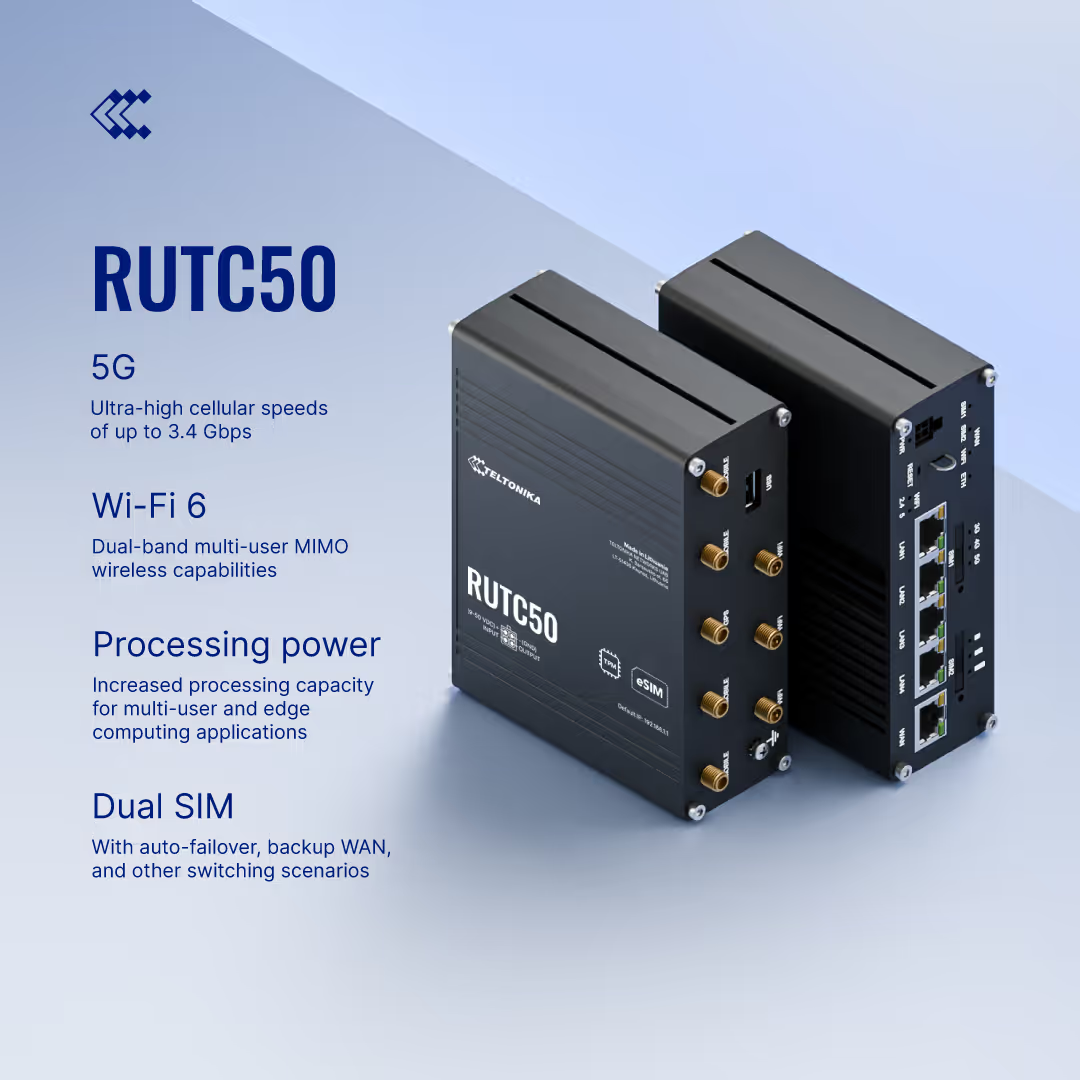
| Teltonika RUTC50 | 5G, up to 3.4 Gbps | 1 GB RAM, 8 GB flash, 5 Gigabit Ethernet ports, dual SIM and eSIM, 3x3 MU-MIMO Wi-Fi 6 on 5 GHz, Docker |
| Teltonika RUTC54 | Global 5G (Telit modem) | Dual SIM and eSIM with auto-failover, dual-band MU-MIMO Wi-Fi 6, Docker |
The RUTC16 is the only 4G model in the RUTC range with LTE Cat 6. Carrier aggregation is a technique that combines two or more LTE frequency channels into one connection. The 3GPP standards set a peak download of 300 Mbps for LTE Cat 6, twice the 150 Mbps of LTE Cat 4 used in the RUTC40, RUTC41 and RUTC42.
Keep platform and model choice separate. Platform C sets what the hardware can do, while the right model depends on the cellular technology, resilience needs, interfaces and site conditions. Our RUTC series guide covers model selection in detail.
When Should You Specify a Platform C Router?
Specify a Platform C router when the router must carry encrypted traffic, host local software or serve many Wi-Fi clients, and still behave as a dependable network device.
A Platform C router is a good fit for sites that need:
- Several IPsec tunnels or encrypted links at speeds close to the cellular connection.
- Software on the router, such as protocol translation, data filtering or local control logic in Docker.
- High Wi-Fi client counts, for example events, temporary sites or retail spaces with tablets, terminals and cameras.
- A replacement for an RUTX router reaching end of life.
A Platform C router is more than some sites need. A single sensor or meter sending small readings over one connection, with no VPN load or local software, can run on a simpler router from our cellular router range. The design aim is to add headroom where the workload needs it, rather than relying on perfect conditions to meet performance targets.
Talk to Millbeck About Platform C Projects
Millbeck is a Teltonika Diamond distributor and IoT SIM provider based in Leeds, UK. We can help you map a Platform C project to a complete bill of materials: the right RUTC router, antennas for the site and IoT SIMs that match the deployment. We can also supply routers configured and ready to install, and you will speak directly to people who know the technology.
Speak to us about your project
Millbeck. IoT Connectivity
Frequently Asked Questions
Is Teltonika Platform C a Router Model?
No. Teltonika Platform C is a hardware platform, a system on chip design, rather than a product you order. Teltonika builds the RUTC series on it: the RUTC16, RUTC40, RUTC41, RUTC42, RUTC50 and RUTC54. You choose a model for its cellular type, ports and resilience features, and Platform C sets the processing, Wi-Fi and encryption capability underneath.
Can a Firmware Update Add Platform C Features to an Older Teltonika Router?
No. Platform C features such as the hardware crypto engine, the Cortex-A53 processor and Wi-Fi 6 radios are physical parts of the chip, so a firmware update cannot add them to an older router. RutOS updates can add software features, but hardware VPN acceleration and Wi-Fi 6 need a Platform C device.
Is the RUTC50 a Replacement for the RUTX50?
Yes. Teltonika lists the RUTC50 and the RUTM50 as replacements for the RUTX50, which is entering end of life. Teltonika gives 3 February 2027 as the last order date for the RUTX50. Millbeck can help you choose between the two for your site.
How Many Wi-Fi Devices Can a Teltonika RUTC Router Support?
Teltonika states that the RUTC50 can manage up to 512 concurrent users on dual-band Wi-Fi 6. Teltonika does not publish the same figure for every RUTC model, so check the datasheet for the other RUTC models. The number of users the site can serve well also depends on the cellular uplink they share.
Do Platform C Routers Support OpenVPN and WireGuard?
Yes. Teltonika RUTC routers run RutOS, Teltonika's router operating system, which supports IPsec, OpenVPN and WireGuard on every RUTC model. Teltonika's published speed gain from the Platform C crypto engine refers to IPsec only. If a design depends on OpenVPN or WireGuard throughput, test that protocol on the router before you specify it.
Can Teltonika RMS Manage Platform C Routers?
Yes. Teltonika RMS (Remote Management System) is Teltonika's cloud platform for monitoring, configuring and updating routers across an estate, and it manages RUTC routers built on Platform C. Teltonika's own Platform C example used RMS to monitor device health and performance. Millbeck covers the service on our Teltonika RMS page.
Sources and Further Reading
- Teltonika Networks: Platform C, Reinventing Industrial Network Technology (May 2025)
- Teltonika Networks: How to Deploy Docker on Industrial Cellular Routers (July 2026)
- Teltonika Networks: RUTC50
- Teltonika Networks Wiki: RUTC50
- Teltonika Networks: RUTC16
- Teltonika Networks: RUTC40
- Teltonika Networks Wiki: RUTC41
- Teltonika Networks: RUTC42
- Teltonika Networks: RUTC54