IoT Connectivity, Explained
If you are new to IoT, the terminology can feel like a wall. Cellular SIMs, private APN, LTE-M, NB-IoT, eUICC, MIMO, MQTT, Modbus, SCADA, CGNAT. It can be hard to work out what applies to your project, what you actually need, and what is sales noise.
This page is a plain-language introduction. If you are trying to connect devices, sensors, cameras, meters, vehicles, or machines to a network so you can collect data from them or control them remotely, you are in the right place. We will explain what IoT connectivity is, the main decisions you need to make, and where Millbeck fits.
In short: IoT connectivity is the cellular, fixed, or wireless link that connects a device to the internet or to a private network. Most commercial and industrial IoT projects use cellular SIMs, often paired with an industrial router and an antenna, because cellular works almost everywhere and does not depend on site infrastructure. Millbeck supplies the SIMs, hardware, and expertise to design and run these deployments, whether you are connecting ten devices or ten thousand.
What Is IoT, Really?
IoT, or the Internet of Things, is the simple idea that physical objects can be connected to a network and exchange data. A parking meter that reports when it is full. A CCTV camera that streams to a control room. A weather sensor on a wind turbine. A vending machine that orders its own stock. A fleet of delivery vans tracked in real time.
Everything in that list needs three things: a device that generates the data, a connection that sends the data somewhere useful, and a platform or system that does something with the data. Millbeck works on the middle layer: the connection.
What Connectivity Options Exist?
There are several ways to connect an IoT device, and the right choice depends on what the device does and where it is deployed.
Cellular (4G, 5G, LTE-M, NB-IoT): the most common choice for commercial IoT. Works almost anywhere with mobile coverage, no dependency on site Wi-Fi or fixed broadband. LTE-M and NB-IoT are low-power variants designed for battery-powered devices that send small amounts of data.
Wi-Fi: fine if the device sits inside a building with reliable Wi-Fi, but rarely viable for devices in the field, on the road, or in remote locations. Wi-Fi also ties you to the venue’s IT and introduces security and stability concerns.
Fixed broadband: works when a dedicated fibre or cable line is available, but installation can take weeks or months, civil works are expensive, and many sites cannot justify the cost.
LoRaWAN: a low-power long-range wireless option suited to very large sensor networks where individual devices send tiny amounts of data (soil moisture, environmental monitoring, utility metering). Usually paired with a LoRaWAN gateway that backhauls data over cellular.
Satellite: relevant for truly remote locations with no cellular coverage, though hardware and airtime costs are higher. Satellite-cellular hybrid solutions are emerging for the hardest environments.
For most commercial IoT deployments, cellular is the default, often with LoRaWAN for wide-area sensor networks and satellite as a fallback for the most remote sites.
What About the Hardware?
A SIM alone is not always enough. Most IoT deployments also need hardware that manages the connection.
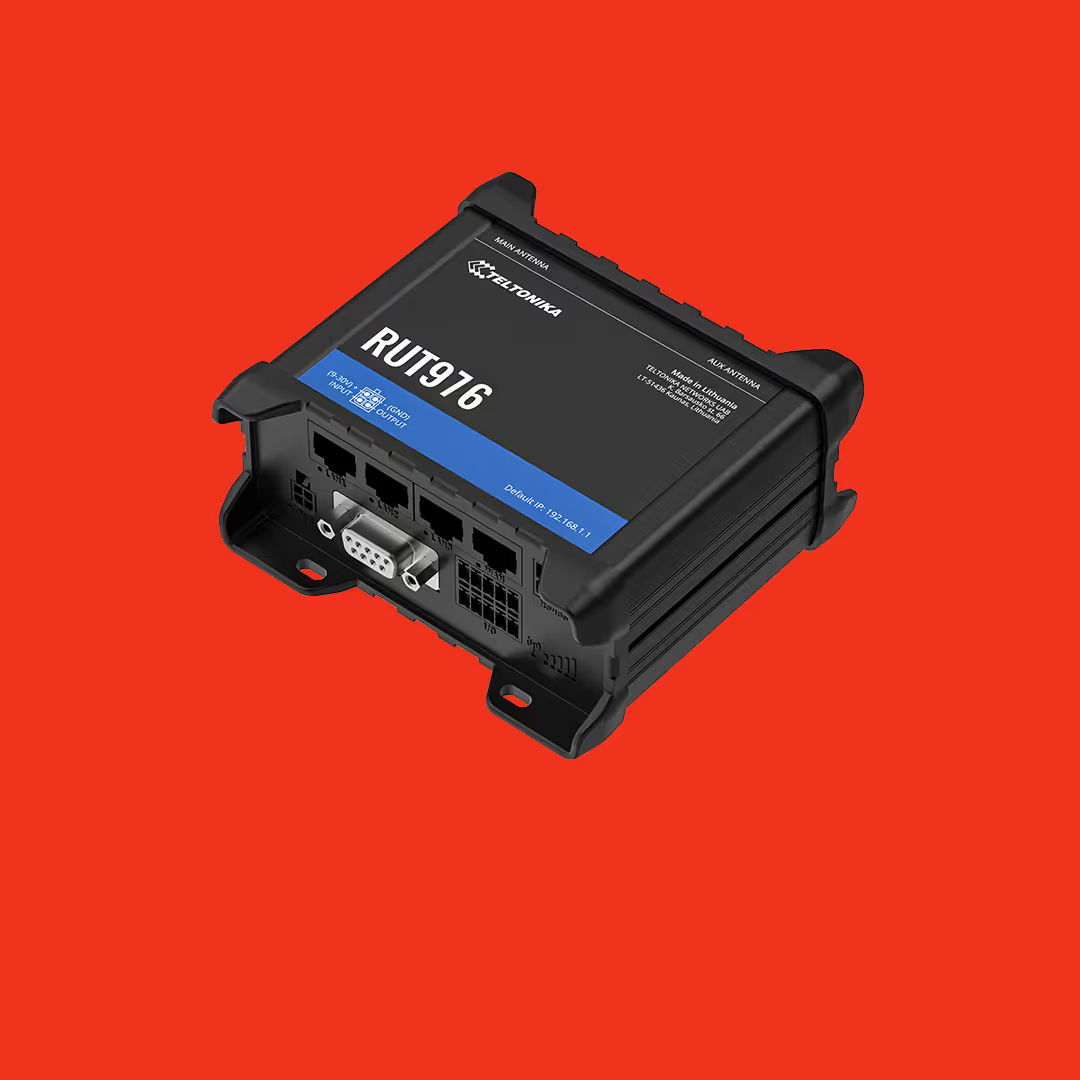
Cellular routers: industrial-grade routers that take a SIM and provide a stable, managed connection to the internet or a private network. They usually include features like dual-SIM failover, VPN, and support for connecting older equipment via serial interfaces.
Gateways: similar to routers but often specialised for specific use cases, such as LoRaWAN gateways for sensor networks, or Serial-to-IP gateways for legacy equipment.
Embedded modules: the cellular chip integrated directly into the device itself, common when an OEM is building a new product with connectivity built in.
Antennas: easily overlooked but genuinely important. The right antenna choice can turn an unreliable site into a stable one, and the wrong choice can create weeks of troubleshooting.
What Is a Multi-Network SIM?
A multi-network SIM is a single SIM that can connect to more than one mobile carrier. Instead of being locked to EE, Vodafone, O2, or Three, it connects to whichever has the strongest signal at that location, and switches automatically if the primary carrier has an outage.
This matters because single-carrier SIMs fail in two common ways: weak signal at the site (one network has terrible coverage in that specific spot) and outages (the whole network goes down). Multi-network SIMs solve both.
Most commercial and industrial IoT deployments today use multi-network SIMs as the default, because the cost difference is small and the reliability difference is significant.
How Do I Keep IoT Data Secure?
Two standard tools cover most of the security requirement for commercial IoT: private APNs and fixed private IPs.
Private APN (Access Point Name): routes your cellular data through a dedicated, isolated path rather than the public internet. Devices are not addressable from the outside world, which removes the main attack vector that affects consumer-grade IoT.
Fixed private IPs: give your devices a consistent address on the private network so you can manage them remotely through a VPN, without exposing them publicly.
Combined with encrypted VPN tunnels between your sites and your operations centre, this is the standard architecture for any IoT deployment where data sensitivity or regulatory compliance matters.
How Do I Manage Lots of Devices at Once?
A SIM management platform lets you see every SIM in your estate, monitor usage and performance, activate or suspend SIMs, and receive alerts when something goes wrong. For anything beyond a handful of devices, it is essential.
Good SIM management is the difference between knowing your estate is healthy and finding out a device has been offline for three weeks when the customer phones. It also controls cost, because unmanaged SIMs tend to rack up unexpected bills from rogue data usage.
Where Does Millbeck Fit?
Millbeck is an IoT connectivity specialist based in Leeds. We supply the SIMs, hardware, and support that commercial and industrial IoT deployments rely on.
Multi-network and global IoT SIMs for UK and international deployments.
Teltonika industrial routers and gateways (we are a Teltonika Diamond distributor) plus hardware from Milesight, Robustel, Cradlepoint, Proroute, and others.
Antennas and expert advice on selection and placement, because getting this right at design stage removes more field visits than any other single change.
A SIM management platform for estate-scale visibility and control.
Specialist support from engineers who know the difference between a consumer SIM and a plant-room SIM, and who will help you design the right solution for your specific project.
Whether you are connecting a handful of pilot devices, scaling to thousands, or somewhere in between, we will help you figure out what you actually need, and then supply it.
Frequently Asked Questions
What Is IoT in Simple Terms?
IoT means connecting physical objects (devices, sensors, machines, vehicles) to a network so they can exchange data with other systems. The purpose is usually to monitor something remotely, control something remotely, or gather data for analysis and decision-making.
What Is the Difference Between IoT and M2M?
M2M (machine-to-machine) is an older term that usually describes direct device-to-device communication, often over cellular. IoT is broader: it covers the same technology plus everything that sits around it (cloud platforms, analytics, user applications). In practice the two terms are often used interchangeably, though IoT has largely replaced M2M in modern usage.
Do I Need a SIM Card for IoT?
For most cellular IoT deployments, yes. The SIM is what identifies your device on the mobile network and authorises it to use airtime. Modern devices may use eSIM (embedded SIM) technology rather than a physical SIM card, but the function is the same.
What Is the Best Connectivity Option for My IoT Project?
It depends on where the devices are deployed, how much data they send, how often they send it, and what your power and cost constraints are. Cellular 4G and 5G suit high-data, powered devices. LTE-M and NB-IoT suit low-data, battery-powered sensors. LoRaWAN suits very large networks of simple sensors. Fixed broadband suits static indoor locations with infrastructure already in place. Most real projects use a combination, and the right answer is worth a conversation rather than a guess.
How Much Does IoT Connectivity Cost?
Cellular IoT SIM pricing depends on data allowance, number of SIMs, contract length, and features like private APN or fixed IP. Typical managed IoT SIM plans range from a few pounds per month for small data allowances to more for high-data or specialised requirements. Hardware costs vary widely based on device type and specification. For a meaningful estimate, talk to a connectivity specialist about your actual project parameters.
Can Millbeck Help Me Even if I Don’t Know What I Need Yet?
Yes. A lot of our customers come to us at exactly that stage. We help scope the project, suggest the right SIM and hardware combination, and often save customers money by steering them away from over-specified hardware or under-specified connectivity. The conversation costs nothing and often saves a lot.
This is some text inside of a div block.
-min.webp)



.png)











.png)
.png)