AIoT: Why The Next Wave Of IoT Will Be Shaped At The Edge
Artificial Intelligence and IoT are converging into AIoT, where on-device intelligence sits alongside cellular connectivity rather than relying solely on the cloud. Transforma Insights forecasts AIoT connections will grow from 1.4 billion in 2023 to 9.1 billion by 2033, a CAGR of over 20%. For anyone specifying connectivity today, the implications are practical: more capable routers, smarter data planning, and a clearer split between what runs at the device and what runs in the cloud.
What AIoT Actually Means
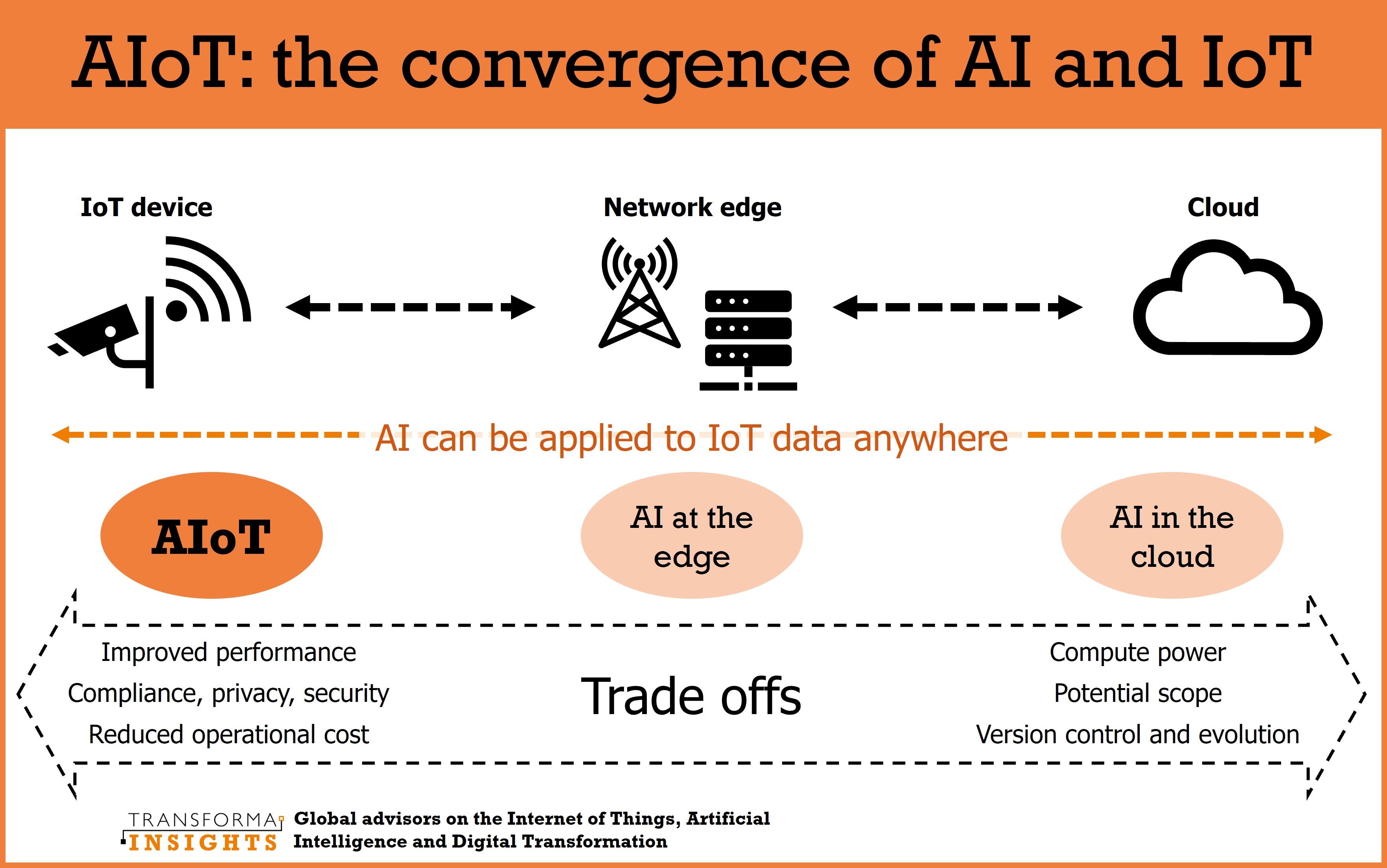
AIoT is the combination of Artificial Intelligence and the Internet of Things. The distinction that matters is where the AI runs. Data generated by an IoT device can be processed in the cloud, on a gateway, at the network edge, or on board the device itself. In practice, most real-world deployments use a combination of these. Intelligence is increasingly embedded throughout the stack rather than concentrated in one layer.
When the AI runs on the device, the deployment qualifies as AIoT in the strict sense. Transforma Insights uses this narrower definition in its forecasts, and it is a useful one. It separates true on-device intelligence from cloud-hosted AI that simply analyses IoT data after the fact. Both have value, and most production systems use both. But they make very different demands on the connectivity layer underneath them.
The Forecast
The headline figures from Transforma Insights' January 2025 AIoT forecast give a sense of scale:
- 1.4 billion AIoT devices at the end of 2023, growing to 9.1 billion by 2033
- A compound annual growth rate of over 20%
- AIoT penetration of all IoT devices rising from 9% in 2023 to 23% by 2033
- The total IoT installed base growing from 16 billion to 39 billion devices over the same period
By 2033, 80% of AIoT devices will sit in the consumer sector. Within enterprise, the largest categories are cross-vertical use cases (generic office equipment, fleet vehicles), government applications (most prominently CCTV), and health. Geographically, China, North America, and Europe account for around 77% of the total worldwide.
Source: Transforma Insights, AIoT forecast announcement, January 2025.
For broader context, Mordor Intelligence valued the AI in IoT market at around USD 35.10 billion in 2025, and Ericsson projects close to 7 billion cellular IoT connections globally by the end of the same year. These figures are not directly comparable to Transforma's device count, but they point in the same direction. AI is moving into the IoT estate quickly.
Why On-Device AI Matters For Connectivity
There is a simple reason AIoT shifts intelligence on board the device: cloud round-trips are expensive in latency, bandwidth, and operational risk. Processing data locally changes the economics of an IoT deployment in four ways.
Latency. Decisions made on the device happen in milliseconds. A CCTV camera that classifies an event on board only sends a clip when something matters. A controller that runs local logic does not wait for a cloud response before acting.
Bandwidth and data costs. Raw IoT data volumes are large and growing. Filtering at the edge means cellular networks carry useful events, not raw streams. Over the lifetime of a deployment, this is the difference between a viable data plan and an unsustainable one.
Privacy and security. Data processed and discarded on the device never leaves the local network, which reduces the attack surface and simplifies compliance with data residency and privacy obligations. Bosch Research frames this as a question of trust and data sovereignty: AIoT adoption depends on customers being confident that their data is handled, stored, and protected appropriately. For regulated environments, this is increasingly the deciding factor in an architecture review.
Resilience. A site that depends on the cloud to function is offline whenever the connection drops. A site with local intelligence keeps running, then synchronises when the link returns.
None of this removes the need for connectivity. It changes the role of the connectivity device. The router is no longer a passive pipe to the cloud. It is the local control point that decides what gets sent, when, and over which network.
Where AIoT Lands First
Transforma's forecast is not uniform across applications. The differences are useful to anyone planning a deployment.
By 2033, around 77% of IoT AV equipment will be AIoT, with on-board intelligence handling tasks such as image recognition, voice processing, and access control. CCTV is one of the clearest enterprise use cases. The same is true for personal and home electronics, vehicle head units, and security alarms.
At the other end, applications such as inventory monitoring and building lighting will remain almost entirely cloud or gateway-based. The economics do not justify on-device AI when the data is simple and the decisions are not time-critical. AI still plays a role, but it sits in the cloud or on a gateway, not on the sensor itself.
From an AI capability perspective, Natural Language Processing leads adoption, followed by Chatbots and Digital Assistance, then Image Processing and Analysis. The first two cluster around smart speakers and consumer devices. The third lands squarely in enterprise, particularly CCTV and gesture-based interfaces.
For Millbeck customers specifying industrial deployments, the practical implications are concentrated in a few areas: video surveillance and access control, asset and fleet telematics, predictive maintenance in manufacturing and utilities, EV charging infrastructure, and grid-edge energy applications. These are the places where on-device AI changes the design, not just the marketing.
What This Means For The Cellular Router
Cellular routers used to be specified almost entirely on connectivity criteria: cellular category, throughput, SIM count, VPN support. Those criteria still matter. They are no longer sufficient.
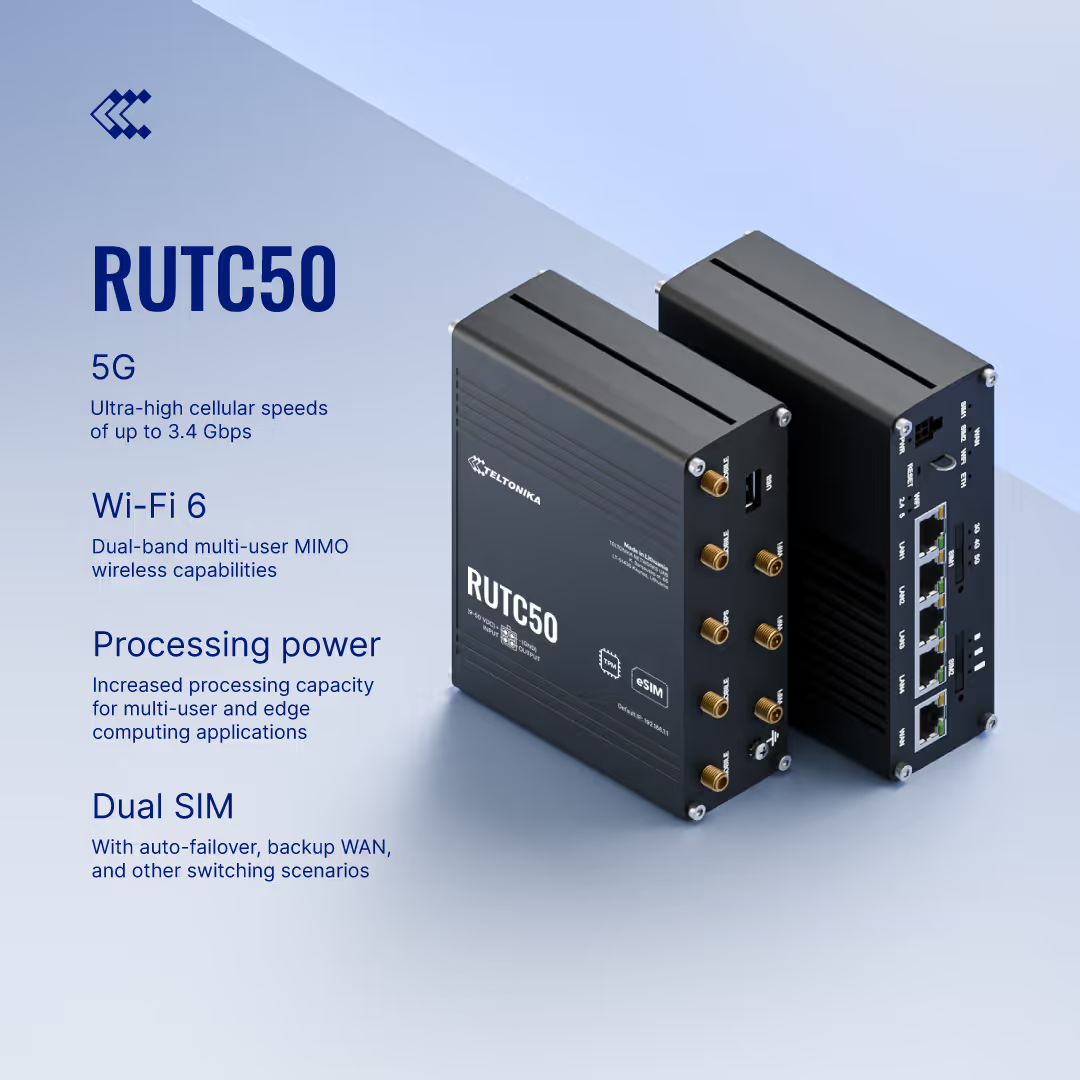
An edge-capable router is now expected to do more than route traffic. The direction of travel is visible in recent hardware from manufacturers including Teltonika, with newer models pairing LTE connectivity with multi-core processors, gigabytes of RAM and onboard storage, and container support. That is a meaningful change. It moves the router from a box that connects things to a box that can run things. See, for example, the RUTC series devices.
The practical question for anyone designing a new deployment is no longer solely "which router has the right cellular spec" but "where does the intelligence sit, and what does that mean for the hardware at each site." A few patterns are emerging:
- Sites with one or two simple devices and cloud-based logic continue to use compact 4G routers with strong remote management.
- Sites with local processing requirements, multiple downstream devices, or strict uptime targets benefit from edge-capable routers running containers for protocol conversion, local rules, or buffering.
- Sites running high-bandwidth applications such as live video or 5G fixed wireless access need 5G hardware, often with eSIM and multi-SIM resilience.
This is not a recommendation to over-specify every site. It is a recommendation to specify deliberately, based on what the application actually needs at the edge.
What This Means For IoT SIMs
If more processing happens on the device, the data profile of a deployment changes. Filtered, event-driven traffic looks very different to raw telemetry. That has knock-on effects on SIM specification.
Data plans. Plans sized for raw streaming may be over-provisioned for AIoT deployments that only send filtered events. The reverse can also be true: applications that periodically sync large model updates or video clips need plans that absorb burst traffic without surprise charges.
Private addressing. As deployments scale, public IP addressing on SIMs is no longer acceptable from a security perspective. Private IP SIMs combined with platform-based remote access are now the default for industrial estates.
Resilience. Multi-network roaming SIMs and eSIM (eUICC) provisioning matter more when the device cannot be allowed to fall offline. If the device is making local decisions and storing data between syncs, an extended outage is not a soft failure. It is a data and compliance issue.
The shorter version: AIoT raises the stakes on connectivity design. The device is doing more, so the connectivity around it has to be more deliberately specified.
How To Plan A Deployment With AIoT In Mind
For most enterprise deployments, AIoT does not mean rebuilding everything from scratch. It means asking a few questions earlier in the design process.
- What decisions, if any, need to be made at the device in real time?
- What data needs to leave the site, and what can stay local?
- What is the cost of a connectivity outage in operational and compliance terms?
- How will the deployment handle data sovereignty, security, and customer trust over the long term?
- Does the router need to host containers, or is a simpler device sufficient?
- What does the SIM and data plan look like once filtering is in place?
Working through these questions early avoids the common pattern of bolting a connectivity device on at the end of a project and discovering that the architecture cannot support what the application actually does.
Where Millbeck Fits
We supply the connectivity layer that AIoT deployments rely on: cellular routers, IoT SIMs, and antennas, paired with the technical advice that decides which combination is right for a given site. We are an IoT SIM provider and a Teltonika Diamond distributor, we work with senior engineers and purchasing teams who need a named contact, not a ticket queue.
If you are scoping a new deployment, refreshing an ageing estate, or weighing edge-capable hardware against cloud-only architectures, we are happy to help work through the trade-offs.
Millbeck. IoT Connectivity.
Frequently Asked Questions
What Is The Difference Between IoT And AIoT?
IoT refers to connected devices that generate and exchange data. AIoT adds an artificial intelligence layer that turns that data into decisions, often in real time. In practice, AIoT can run in the cloud, on a gateway, or on board the device itself. The strict definition used by forecasters such as Transforma Insights focuses on AI that runs on the device. The distinction matters because it changes the latency, bandwidth, security, and resilience profile of a deployment.
Does AIoT Replace Cloud-Based Analytics?
No. Most AIoT deployments combine on-device intelligence with cloud analytics. The device handles real-time decisions and data filtering. The cloud handles longer-term analysis, model training, and fleet-wide reporting. The shift is in where each task happens, not in eliminating one or the other.
Do I Need A 5G Router For An AIoT Deployment?
Not necessarily. The right cellular standard depends on the application's bandwidth, latency, and coverage requirements, not on whether AI is involved. Many AIoT deployments run on 4G LTE because filtered, event-driven traffic does not need 5G throughput. 5G becomes the right choice for high-bandwidth applications such as live video or 5G fixed wireless access.
What Is An Edge-Capable Router?
An edge-capable router is a cellular router with enough processing power, memory, and storage to run applications locally, in addition to its routing and connectivity functions. Newer industrial models from manufacturers such as Teltonika add container support, typically Docker, allowing protocol conversion, local rules engines, or analytics to run on the router itself rather than on a separate gateway.
How Does AIoT Affect IoT SIM Data Plans?
AIoT often reduces raw data volumes by filtering events locally, which can lower data plan requirements. It can also introduce burst traffic for model updates or large event payloads. Either way, the data profile of an AIoT deployment is different to a cloud-first deployment, and plans should be sized against the actual traffic pattern rather than a worst-case estimate.
Is AIoT More Secure Than Cloud-Based IoT?
It depends on the design. Processing data on the device can reduce the attack surface and limit exposure of sensitive information, because data does not have to travel to the cloud to be useful. That supports data sovereignty and regulatory compliance. The trade-off is that intelligent edge devices become more valuable targets, so security has to be designed into the hardware, firmware, and connectivity from the outset rather than added later.
Which Industries Are Adopting AIoT Fastest?
According to Transforma Insights, the largest enterprise categories for AIoT adoption by 2033 will be cross-vertical use cases (such as office equipment and fleet vehicles), government applications (most prominently CCTV), and health. Image processing and computer vision are the most common AI capabilities found on board enterprise AIoT devices.
Sources
- Transforma Insights, "Transforma Insights publishes industry-leading forecasts for AIoT," 16 January 2025. Available at: https://transformainsights.com/news/aiot-forecast-ai-iot
- Teltonika Networks, "AIoT: Artificial Intelligence and IoT Transforming the Market." Available at: https://www.teltonika-networks.com/newsroom/aiot-artificial-intelligence-and-iot-transforming-the-market
- Sequans / RCR Wireless, "Three trends shaping cellular IoT in 2025 (Reader Forum)," 7 January 2025. Available at: https://www.rcrwireless.com/20250107/fundamentals/cellular-iot-trends-2025-sequans
- IoT For All, "What is AIoT? Applying AI to IoT Data," December 2024. Available at: https://www.iotforall.com/what-is-aiot
- Bosch Research, "AIoT: Artificial Intelligence of Things." Available at: https://www.bosch.com/research/research-fields/digitalization-and-connectivity/research-on-security-and-privacy/aiot-security/
- Mordor Intelligence, AI in IoT market sizing, 2025. https://www.mordorintelligence.com/industry-reports/artificial-iintelligence-of-things-market
- Ericsson Mobility Report, cellular IoT connections forecast for 2025.