Connectivity for Utility Networks
Water, gas, electricity distribution, and heat networks all share the same operational challenge: thousands of distributed endpoints, generating data that the utility needs to see continuously, spread across geographies where fixed-line connectivity is rarely available or economic.
Millbeck provides the resilient, secure cellular connectivity layer that keeps smart meters, transformer monitors, pressure sensors, grid automation, and supervisory systems online, across urban, rural, underground, and offshore deployments. From individual meter endpoints through to utility-scale SCADA backhaul, we pair multi-network IoT SIMs with industrial Teltonika routers and the antenna expertise that makes the difference between a site that works and a site that needs a monthly engineer visit.
In short: Millbeck supplies multi-network IoT SIMs, Teltonika industrial routers, and antenna expertise to water, gas, electricity, and heat network operators across the UK. Core capabilities include private APN services, fixed private IP addressing for SCADA, LTE-M and NB-IoT connectivity for deep-signal smart metering, and a centralised SIM management platform for estate-scale deployments.
Resilient Multi-Network IoT SIM Connectivity
A multi-network IoT SIM is a single SIM that can connect to multiple mobile carriers and automatically switch between them based on signal strength and availability, giving utility deployments redundancy against single-carrier outages.
Connected utilities demand always-on data flows from thousands of distributed endpoints, from smart meters and transformer monitors to remote grid sensors and pumping stations. Multi-network IoT SIMs switch between carriers when signal quality changes or a network experiences service degradation. This dynamic behaviour supports high network availability, reducing the risk of data gaps, downtime, and costly field visits to troubleshoot connectivity issues.
Multi-network SIMs also simplify large-scale and cross-regional rollouts. Instead of managing separate operator agreements and multiple SIM types, utilities can deploy one SIM that works across networks and, where relevant, across borders, cutting admin complexity and getting sites online faster.
Adaptive Coverage and Redundancy for Critical Operations
Adaptive coverage means a SIM can change which carrier it uses in real time. In a utility context, this removes the single points of failure that cause long outages, because a weakening or failed primary network triggers automatic switching to an alternative carrier with better signal.
In utility environments, whether urban, rural, underground, or offshore, single-operator coverage can be inconsistent. Multi-network SIMs provide built-in redundancy. If a primary network weakens or fails, devices automatically engage an alternative operator with better signal strength.
This matters most for mission-critical telemetry, grid automation, and fault alerting systems, where even brief connectivity loss can delay decision-making or compromise operational safety. By extending cellular reach across diverse geographies and carrier footprints, multi-network SIMs also protect utility deployments against future network plan changes and spectrum retirements such as the ongoing 2G and 3G sunset.
Cellular Routers, Connectivity Hubs for Distributed Infrastructure
Cellular routers sit between the utility’s operational devices and the mobile network, providing secure, managed connectivity for meters, sensors, controllers, and legacy systems at the site edge.
Cellular routers are the connectivity backbone of modern utility infrastructure, securely linking meters, sensors, controllers, and legacy systems to central platforms.
As a Teltonika Diamond distributor, Millbeck supplies industrial routers built for harsh, distributed utility environments, combining 4G, LTE-M, NB-IoT, and 5G connectivity with features such as VPNs, firewalling, protocol support, and remote management. This makes them the standard choice for substations, plant rooms, street cabinets, pumping stations, and other unattended utility locations.
For HVAC, plant, and legacy system integration, Teltonika routers expose operational data from existing controllers over secure cellular links. Utilities can monitor performance, identify inefficiencies, and implement predictive maintenance without replacing core equipment, extending asset life while lowering operational costs across geographically dispersed sites.
For district heating and smart metering, Teltonika routers act as reliable data concentrators, collecting consumption data from multiple meters over M-Bus and transmitting it upstream via secure cellular connections. High-throughput LTE routers support low-latency, resilient communication for billing, analytics, and fault detection, while also supporting mobile field operations through secure connectivity in service vehicles and temporary sites.
Antennas, Maximising Signal Quality and Reliability
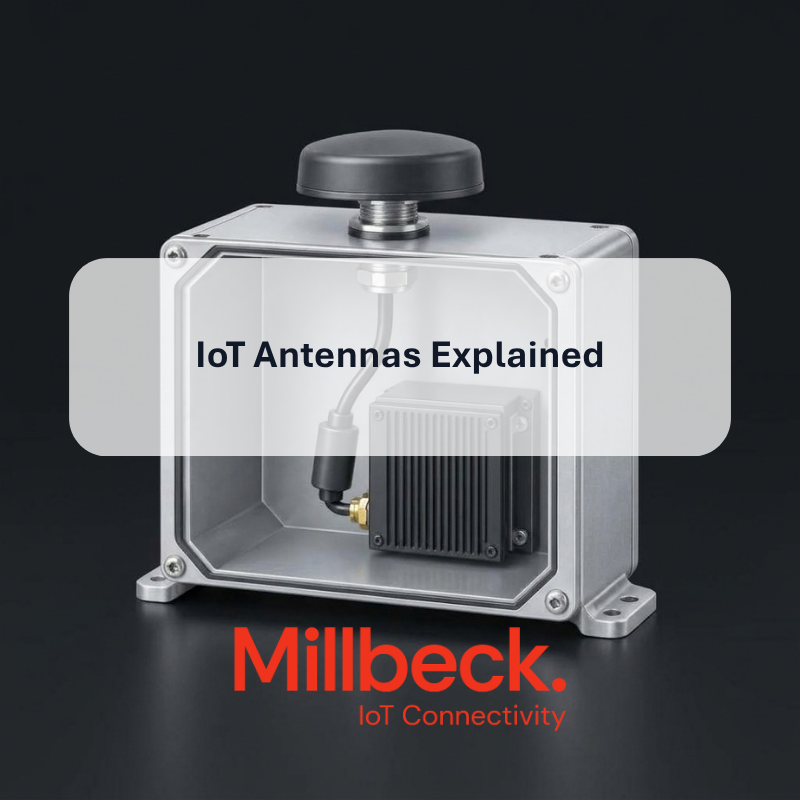
Antenna selection and placement are often the single biggest factor in whether a utility deployment works reliably in the field.
Antennas convert between radio waves and electrical signals, and their design directly affects coverage, throughput, and reliability across the environments utilities operate in, from substations surrounded by steel infrastructure to remote pumping stations with no line of sight to the nearest mast.
Modern cellular deployments use MIMO (Multiple Input, Multiple Output) antenna configurations that exploit multiple transmit and receive paths, increasing link capacity and resistance to interference. This is particularly valuable for LTE and 5G, where MIMO enhances signal robustness and data rates across complex propagation conditions.
Selecting the right antenna type, for example omnidirectional for broad area coverage or directional for targeted links, and ensuring proper mounting on elevated rooftops, poles, or metal structures, minimises signal attenuation and maximises uptime. Antenna selection is part of the conversation we have with every utility customer, because getting this right at design stage removes more field visits than any other single change.
Secure, Managed Connectivity at Scale
Managed connectivity means centralised visibility and control over every SIM in the estate, with security features that isolate utility data from the public internet.
Centralised connectivity management is where utility IoT deployments either scale cleanly or fall apart. Millbeck’s SIM management platform tracks usage, performance, and network resilience across thousands of devices, with dashboards and APIs for provisioning, remote updates, profile switching, and alerts for performance anomalies.
This level of control supports operational continuity and network cost control. It also enables the security features utilities depend on: private APNs, fixed or private IP addressing for SCADA systems, and secure VPN tunnels between remote sites and enterprise networks. Sensitive operational data and control signals stay isolated from the public internet throughout.
From individual meter endpoints to utility-scale supervisory systems, Millbeck provides the connectivity layer that water, gas, electricity distribution, and heat network operators rely on to keep their networks visible and controllable. Built on Teltonika hardware, secured by private APN and VPN, and backed by the antenna and deployment expertise that determines whether utility IoT works in the field or sits on a planner’s desk.
Frequently Asked Questions
What Connectivity Do UK Utilities Use for Smart Meters?
UK utilities typically use LTE-M and NB-IoT cellular connectivity for smart meter deployments. These low-power wide-area technologies are specifically designed to penetrate reinforced concrete basements and meter cupboards, and they support device battery lifecycles of 10+ years, matching the operational life of utility metering hardware.
What Is a Private APN and Why Do Utilities Use It?
A private APN (Access Point Name) routes cellular data through a dedicated, isolated network path rather than the public internet. For utilities, this keeps SCADA traffic, meter data, and control signals off the open internet, reducing the attack surface and supporting compliance with security frameworks such as the UK NIS Regulations.
How Does Multi-Network SIM Redundancy Work?
A multi-network SIM can connect to more than one mobile carrier. If the primary network fails or signal quality drops, the SIM automatically switches to the next available carrier without manual intervention, keeping devices online through carrier outages that would take a single-carrier SIM offline.
Can Cellular Connectivity Support SCADA for Utilities?
Yes. Cellular connectivity with fixed private IP addressing and IPsec VPN tunnels is widely used for utility SCADA, including substation monitoring, pumping stations, and pressure sensors. The key requirements are reliable uplink, low jitter, and secure remote access, all of which industrial cellular routers paired with the right SIM can provide.
What Is the 2G and 3G Sunset and How Does It Affect Utilities?
UK mobile operators are phasing out 2G and 3G networks over the coming years. Legacy utility devices using these networks will lose connectivity. The standard migration path is to LTE-M, NB-IoT, or 4G and 5G, depending on the device’s data profile. Utilities with long-life assets should plan migration well ahead of operator deadlines.
Does Millbeck Supply Both SIMs and Routers for Utility Projects?
Yes. Millbeck supplies multi-network IoT SIMs paired with Teltonika industrial routers, including RUT and TRB series hardware, plus antennas and SIM management platform access. This means utility operators can source the full connectivity stack from a single supplier with a single commercial relationship.
This is some text inside of a div block.



.png)
.png)