Subscribe to newsletter
The Teltonika RUTC series is a range of six industrial 4G and 5G edge routers that run applications on the router as well as connecting the site. This guide compares the RUTC16, RUTC40, RUTC41, RUTC42, RUTC50 and RUTC54, and explains which model and IoT SIM suit each type of deployment.
The Teltonika RUTC series is Teltonika Networks' family of edge routers built on Platform C, its dual-core ARM Cortex-A53 chip design. An edge router is a router that processes data and runs software at the site, as well as carrying traffic between the site and the internet or a private network. The series has four 4G models (RUTC16, RUTC40, RUTC41 and RUTC42) and two 5G models (RUTC50 and RUTC54).
Every RUTC model runs the same software and management tools, so one engineering team can specify, configure and support a mixed estate. The models differ in cellular technology, band coverage and the number of modems. For a closer look at the chip itself, see our guide to Teltonika Platform C.
What Makes a Teltonika RUTC Router an Edge Router?
A Teltonika RUTC router is an edge router because it has the processing power, memory and storage to run containerised applications alongside its routing, firewall and VPN work.
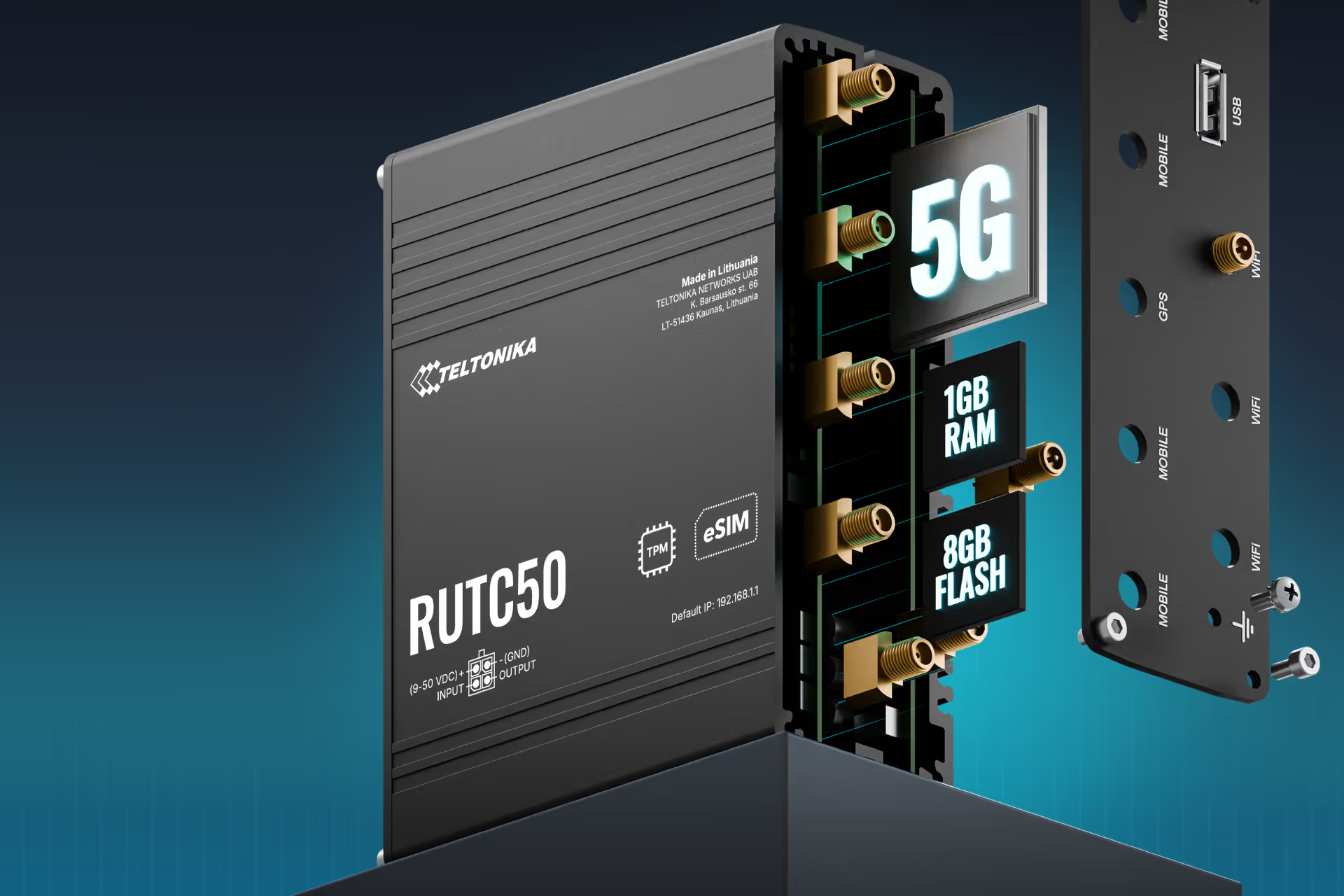
Teltonika specifies a dual-core 1.3 GHz ARM Cortex-A53 CPU, 1 GB of RAM and 8 GB of flash on the RUTC40, RUTC41 and RUTC42, and 1 GB of RAM with 8 GB of flash on the RUTC50. That leaves room to host small services on the router itself, which a router sized only for routing and VPN cannot do.
Docker is software that packages an application and everything it needs into a container, a self-contained unit that runs the same way on any compatible device. Teltonika lists Docker support on all six RUTC models. Engineers can deploy containers with the tools they already use on Linux servers, instead of learning a vendor-specific development kit.
RutOS is Teltonika's router operating system, and it provides the networking layer underneath the applications. RutOS supports industrial protocols such as Modbus and MQTT, and VPN protocols including IPsec, OpenVPN and WireGuard. Teltonika RMS (Remote Management System), Teltonika's cloud platform for monitoring and updating routers, manages RUTC routers alongside the rest of a Teltonika estate.
Why Run Applications on the Router Instead of the Cloud?
Running applications on the router reduces the data a site sends over cellular, keeps local decisions fast, and keeps essential logic working when the mobile connection drops.
Cloud-first IoT designs send every reading to a central platform for processing. That approach works, but it leaves five problems that edge computing, processing data where it is generated, can solve:
- Cellular data use. Filtering or summarising data on site means the router sends alarms and changes instead of every reading, which cuts data use on metered SIMs.
- Response time. Latency is the delay between a device sending data and getting a response. Decisions made on the router avoid a round trip to a data centre.
- Resilience. Logic hosted on the router keeps running during a network outage, then syncs with the cloud when the connection returns.
- Data location. Some customers want sensitive data processed and stored close to where it is generated. Processing on the router keeps that data on site.
- Hardware on site. A router that hosts software can replace a separate industrial PC or gateway, leaving one fewer device to power, patch and support.
On-site processing has limits. An RUTC router suits lightweight services. Heavy workloads, such as video analytics across several cameras, may still need dedicated compute hardware.
How Do the Six Teltonika RUTC Models Compare?
The six Teltonika RUTC models share Platform C, RutOS, Docker support and Wi-Fi 6, and differ mainly in cellular technology, band coverage and the number of modems.
| Model | Cellular | SIM Options | Best Fit |
|---|---|---|---|
| RUTC16 | Global 4G LTE Cat 6 with carrier aggregation | Dual SIM and eSIM with auto-failover | Faster 4G on one product across several countries |
| RUTC40 | Global 4G LTE Cat 4, up to 150 Mbps down and 50 Mbps up | Two SIM slots and one eSIM | Standard 4G on one product across several countries |
| RUTC41 | 4G LTE Cat 4 for EMEA, Thailand, Australia and New Zealand | Two SIM slots and one eSIM | Fixed 4G sites in the UK and Europe |
| RUTC42 | Two 4G LTE Cat 4 modules, up to 150 Mbps down and 50 Mbps up each | Two Nano SIM slots and two eSIMs, one of each per modem | Sites that cannot depend on one mobile network |
| RUTC50 | 5G up to 3.4 Gbps down | Two SIM slots and one eSIM | High bandwidth, many wired devices and busy Wi-Fi |
| RUTC54 | Global 5G (Telit modem) | Dual SIM and eSIM with auto-failover | 5G on one product across several countries |
An eSIM is a SIM chip built into the router that downloads network profiles remotely, so no removable card is needed. Teltonika's datasheets for the RUTC40, RUTC41 and RUTC50 state that the eSIM holds up to seven profiles. The physical SIM slots stay available for a card-based SIM or a backup network.
Which Teltonika RUTC Model Should You Choose?
Choose a Teltonika RUTC model by answering three questions: does the site need 4G or 5G, will the router ship to more than one region, and can the site tolerate losing one mobile network?
- Global 4G on one product: RUTC40, or the RUTC16 for faster 4G.
- 4G at fixed sites in the UK and Europe: RUTC41.
- No single mobile network as a point of failure: RUTC42.
- 5G speeds and five Gigabit Ethernet ports: RUTC50.
- 5G on one product across several countries: RUTC54.
Teltonika RUTC16: Global 4G With Carrier Aggregation
The Teltonika RUTC16 is a global 4G LTE Cat 6 edge router for deployments that need more 4G capacity than Cat 4 provides. Carrier aggregation is a technique that combines two or more LTE frequency channels into one connection. The 3GPP standards set a peak download of 300 Mbps for LTE Cat 6, twice the 150 Mbps of LTE Cat 4.
Teltonika specifies a Telit modem, dual SIM and eSIM with auto-failover on the RUTC16, and lists it as a replacement for the RUTX11. The RUTC16 suits multi-country rollouts where one product code simplifies stock and logistics.
Teltonika RUTC40: Global 4G on One Product
The Teltonika RUTC40 is a global 4G LTE Cat 4 edge router with a Telit modem, so one product code can ship to many countries without matching a regional band plan. Teltonika's datasheet specifies up to 150 Mbps download and 50 Mbps upload, two SIM slots plus an eSIM, five Gigabit Ethernet ports and GNSS positioning.
The RUTC40 suits fleet and vehicle projects, smart city work and industrial deployments spread across several countries. For fixed sites that stay in one region, the RUTC41 is usually the better fit.
Teltonika RUTC41: 4G for UK and European Fixed Sites
The Teltonika RUTC41 is a regional 4G LTE Cat 4 edge router with the same processor, memory and storage as the RUTC40. Teltonika's datasheet lists band support for EMEA, Thailand, Australia and New Zealand, which covers UK and European deployments.
The RUTC41 suits fixed sites in one region, such as retail branches, utility telemetry, machine-to-machine links and backup internet for offices. Teltonika's datasheet also gives the RUTC41 a higher maximum operating temperature than the RUTC40.
Teltonika RUTC42: Two Modems for Network Diversity
The Teltonika RUTC42 is a dual modem 4G edge router with two LTE Cat 4 modules, so it can hold two live mobile connections at once. Teltonika specifies failover and load balancing between the modems. Each modem has its own Nano SIM slot and eSIM, and can switch between them automatically.
The RUTC42 uses the same dual-core 1.3 GHz CPU, 1 GB of RAM and 8 GB of flash as the RUTC40 and RUTC41, with five Gigabit Ethernet ports and dual-band MU-MIMO Wi-Fi 6. Its operating range is -40 °C to 40 °C, a lower maximum than the RUTC40, RUTC41 or RUTC50.
Load balancing is the spreading of traffic across more than one connection. A dual SIM router with one modem uses one network at a time and must register on the backup network when it switches. A dual modem router keeps both networks connected, so the backup is already online when the primary fails.
The RUTC42 suits payment and retail systems, critical telemetry and remote sites where an engineer visit costs more than the router. Our article on Teltonika dual modem routers compares it with Teltonika's 5G dual modem models.
Teltonika RUTC50: 5G With Five Gigabit Ports
The Teltonika RUTC50 is a 5G edge router for sites that need high bandwidth. Teltonika specifies 5G download speeds of up to 3.4 Gbps. Real speeds depend on the mobile network, whether the site has 5G Standalone or 5G Non-Standalone coverage, and the signal at the site. 5G Standalone (SA) is 5G that runs on its own 5G core network, while 5G Non-Standalone (NSA) adds 5G radio to a 4G core.
Teltonika lists 1 GB of RAM, 8 GB of flash, five Gigabit Ethernet ports, dual SIM with eSIM, GNSS, and dual-band Wi-Fi 6 with MU-MIMO on the RUTC50. The RUTC50 suits live video, temporary event and construction sites, public Wi-Fi and edge analytics, and Teltonika lists it as a replacement for the RUTX50.
Teltonika RUTC54: Global 5G Edge Router
The Teltonika RUTC54 is a global 5G edge router for projects that need 5G on one product code across several countries. Teltonika specifies a Telit global 5G modem, dual SIM and eSIM with auto-failover, dual-band MU-MIMO Wi-Fi 6, Docker support and zero-touch deployment through RMS.
Teltonika positions the RUTC54 as the global 5G model in the RUTC range. If a 5G project spans several countries, check band support for each market before choosing between the RUTC50 and the RUTC54.
Check Operating Temperature for Hot Enclosures
Teltonika's datasheets give an operating range of -40 °C to 75 °C for the RUTC41 and RUTC50, and -40 °C to 65 °C for the RUTC40. The RUTC42 has a lower maximum of 40 °C. Roadside cabinets and rooftop enclosures in direct sun can run hotter than the air around them, so check the datasheet figure for the exact model against the enclosure, not the local weather.
What Can You Run in Docker on a Teltonika RUTC Router?
A Teltonika RUTC router can run lightweight services in Docker, such as protocol translation, data filtering, offline automation and small machine learning models.
- Modbus to MQTT translation. A container reads data from PLCs (programmable logic controllers) over Modbus RTU or Modbus TCP and publishes it as MQTT messages to a cloud IoT platform, without a separate gateway.
- Data filtering for sensors. A container processes readings on site and forwards only events of interest, such as alarms or threshold breaches, which reduces cellular data use.
- Protocol bridging at retail sites. Payment terminals, kiosks and digital signage often use different protocols. A container translates them into one data feed for head office.
- Offline automation. Logic that must keep running during a network outage, such as access control, runs on the router and syncs its state when the connection returns.
- Lightweight inference. Small, optimised machine learning models, such as anomaly detection on sensor data, can run on the router. Test the model on the hardware first, because the processor sets a practical limit.
Our article on industrial serial interfaces, SCADA and MQTT explains how cellular routers connect to industrial equipment.
Add USB Storage for Containers
Teltonika recommends using the router's USB port to add storage for Docker. Container images and logs then sit outside the internal flash, which protects the router's own storage over a long deployment.
Which IoT SIM Should You Pair With a Teltonika RUTC Router?
The right IoT SIM for a Teltonika RUTC router depends on where the router is deployed, how many networks the site needs, and how you will reach the router remotely.
- Multi-country deployments: Global Roaming SIMs let the RUTC16, RUTC40, RUTC50 or RUTC54 connect to local networks in each country where the router is installed.
- UK sites that need resilience: UK Roaming SIMs connect to the strongest available UK mobile network and switch as signal conditions change. A multi-network SIM is a SIM that can connect to more than one mobile operator.
- Remote access: IoT SIMs with fixed IP addressing give each router a consistent address for VPN endpoints, firewall allow lists and management access. A fixed public IP lets you reach the router directly, while a fixed private IP keeps it off the public internet.
- Dual modem resilience: on the RUTC42, put the two SIMs on different mobile networks. Two SIMs on the same network fail together when that network has an outage.
- Touch-free installation: Millbeck IoT eSIMs work with the eSIM built into RUTC routers, so you can deploy without handling SIM cards on site.
Millbeck supplies the RUTC range and IoT SIMs together, so the router and SIM are specified as one order. An APN (access point name) is the setting that tells a router which mobile data gateway to use. We can supply routers configured and ready to install, with APN and VPN settings in place, and you have one supplier to call if a site does not connect.
Talk to Millbeck About Your RUTC Deployment
Millbeck is a Teltonika Diamond distributor and IoT SIM provider based in Leeds, UK. We can help you choose the right RUTC model, pair it with antennas and IoT SIMs for the site, and supply it configured. You will speak directly to people who know the technology.
Speak to us about your project
Millbeck. IoT Connectivity
Frequently Asked Questions
Is the Teltonika RUTC Series 4G or 5G?
The Teltonika RUTC series includes both. The RUTC16, RUTC40, RUTC41 and RUTC42 are 4G LTE edge routers, and the RUTC50 and RUTC54 are 5G edge routers. All six share Teltonika's Platform C chip design, RutOS, Docker support and Wi-Fi 6, so a mixed 4G and 5G estate can be managed the same way.
What Is the Difference Between the Teltonika RUTC40 and RUTC41?
The Teltonika RUTC40 and RUTC41 share the same processor, memory and LTE Cat 4 speeds. The difference is band coverage: the RUTC40 is a global model, while Teltonika's RUTC41 datasheet lists bands for EMEA, Thailand, Australia and New Zealand. The datasheets also give the RUTC41 a higher maximum operating temperature, 75 °C against 65 °C.
Is a Dual Modem Router Better Than a Dual SIM Router?
A dual modem router such as the Teltonika RUTC42 is more resilient, because it keeps two mobile connections live and the backup is already connected when the primary network fails. A dual SIM router with one modem uses one network at a time. Dual SIM suits most sites, while dual modem suits sites where any outage is costly.
Can a Teltonika RUTC Router Replace an Industrial PC?
A Teltonika RUTC router can replace an industrial PC for lightweight services such as protocol translation, data filtering and simple automation, because it runs Docker containers. It is not a like-for-like replacement for heavy workloads. Video analytics across several cameras or large databases still need dedicated compute hardware, so size the workload before removing the PC.
Which Teltonika RUTC Router Replaces the RUTX Series?
Teltonika lists RUTC routers among the replacements for its end-of-life RUTX series. The RUTC16 replaces the RUTX11, and the RUTC50 and RUTM50 replace the RUTX50, which has a last order date of 3 February 2027. Our RUTX end of life article lists every replacement and date.
Can Teltonika RMS Manage a Mixed Estate of RUTC Routers?
Yes. Teltonika RMS (Remote Management System) is Teltonika's cloud platform for monitoring, configuring and updating routers, and it manages every RUTC model. Because all six models run RutOS, an estate that mixes RUTC40, RUTC42 and RUTC50 routers can use the same configuration approach and firmware process from one RMS account.
Sources and Further Reading
- Teltonika Networks: RUTC16
- Teltonika Networks: RUTC40
- Teltonika Networks: RUTC40 Datasheet v1.01 (March 2026)
- Teltonika Networks: RUTC41
- Teltonika Networks: RUTC41 Datasheet
- Teltonika Networks: RUTC42
- Teltonika Networks Wiki: RUTC42 Interfaces
- Teltonika Networks: RUTC50
- Teltonika Networks Wiki: RUTC50
- Teltonika Networks: RUTC54
- Teltonika Networks: Platform C, Reinventing Industrial Network Technology (May 2025)
- Teltonika Networks: How to Deploy Docker on Industrial Cellular Routers (July 2026)


.avif)
