IoT SIM Connectivity for Devices That Need to Stay Online
Every connected device in the field depends on a SIM. It’s a small component, but its choice determines whether the device stays online, stays secure, and stays manageable over a deployment that might last five, ten, or fifteen years. When a SIM fails, so does the service running on it: the missed service visit, the failed transaction, the site that can’t be monitored.
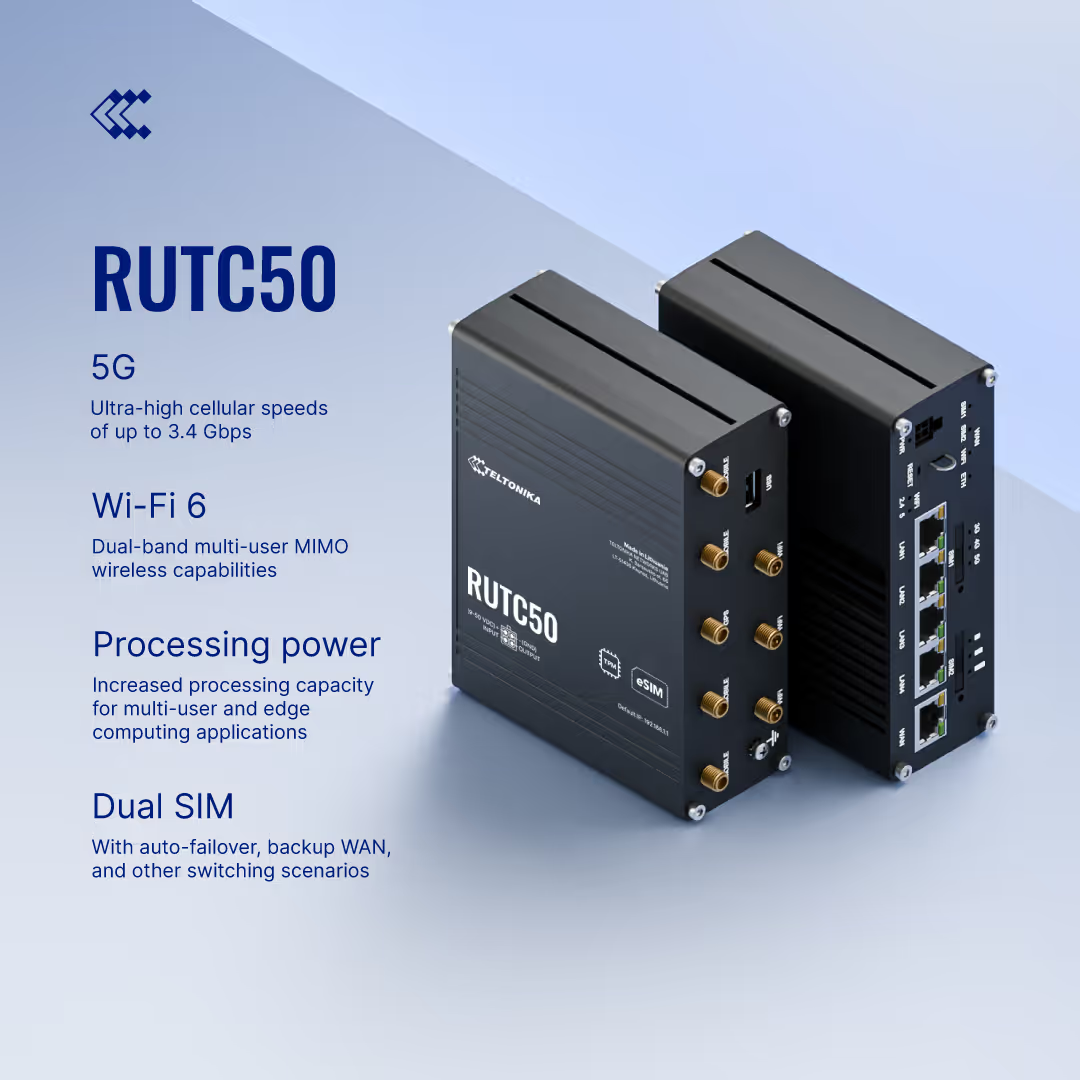
Millbeck supplies IoT SIMs to UK businesses, integrators, and OEMs who cannot afford connectivity to be the weak point. We provide multi-network and global SIMs, eSIM and eUICC variants, private APN and security architecture, and a SIM management platform that gives operators visibility across their estate. Alongside the SIM, we supply the industrial routers, antennas, and deployment advice that complete the connectivity stack. Customers get a named point of contact and direct technical guidance, without the delays and handoffs of a tier-one carrier.
In short: Millbeck supplies multi-network IoT SIMs, global roaming SIMs, eSIM and eUICC variants for the UK and international markets. Coverage extends across 600+ networks in 180+ countries on global roaming products. Security options include private APN, fixed IP, VPN, IMEI lock, data traffic filtering, SMS barring, and voice barring. Every SIM comes with access to our central management platform for provisioning, usage visibility, and estate-wide control.
Why IoT SIM Choice Matters
The SIM is a small line item in a deployment’s bill of materials, but it sets the ceiling on three things: uptime, support cost, and security posture.
A consumer-grade SIM in a connected device may work most of the time, but when it fails, it fails in the ways that cost money. A single-operator SIM leaves devices dependent on one carrier’s coverage at each location. A SIM without central management leaves the operator blind to usage, status, and security events across the estate. A SIM without private networking options exposes device traffic to the public internet.
IoT-grade SIMs exist because these problems compound across a deployment. Ten devices on the wrong SIM is an inconvenience; ten thousand is an operational crisis. The earlier in a project these choices are made, the fewer field retrofits you will pay for later.
Multi-Network IoT SIMs, What They Actually Do
A multi-network IoT SIM can connect to more than one mobile operator in the UK (the post-merger landscape consists of EE, VodafoneThree, and Virgin Media O2, plus the underlying Vodafone and Three radio infrastructure during integration), selecting the carrier with the strongest signal at the device’s current location. If the primary carrier degrades or suffers an outage, the SIM switches automatically to an alternative.
This matters in practice because cellular coverage is not uniform. A site that sits at the edge of one operator’s reach may have strong signal on another. Building construction attenuates different frequencies differently, so one carrier’s signal penetrates a basement or metal enclosure better than another’s. Network congestion patterns vary by operator, time of day, and location. Multi-network SIMs reduce the impact of all three.
Multi-network capability doesn’t replace sound RF design. Antenna selection, router placement, and signal-quality testing still matter. But multi-network does prevent the avoidable failure mode where one operator has poor coverage at a specific site and a single-network SIM has no way to work around it.
The Four Millbeck IoT SIM Options
Different deployments need different SIMs. Millbeck offers four core options, so connectivity can be matched to the geography, lifecycle, and commercial pattern of each project.
UK Roaming IoT SIM. UK roaming IoT SIMs are designed for devices that remain in the UK and need resilience across regions. The SIM connects across multiple UK mobile networks, improving uptime at sites where single-operator coverage is variable. Typical use cases include domestic fleet telematics, smart building controls, EV charging, construction site connectivity, asset tracking, and remote monitoring where single-operator coverage gaps create support cost.
Global Roaming IoT SIM. Global roaming IoT SIMs cover networks across the UK, Europe, and beyond, making them the right choice for deployments that cross borders: international logistics, field equipment that moves between countries, multi-country infrastructure, and OEMs shipping into multiple markets from a single production line. Global roaming SIMs typically support 600+ networks across more than 180 countries. The SIM management platform works across country boundaries, so operators get centralised visibility without managing multiple regional contracts.
eSIM (Embedded SIM). eSIM refers to a SIM soldered into the device’s circuit board rather than inserted as a removable card. For OEMs and manufacturers, eSIM removes SIM handling from the production line, eliminates the risk of physical SIM theft or tampering in the field, and simplifies BOM management across markets. eSIM is particularly relevant for devices deployed in harsh environments, hard-to-reach locations, or high-volume products where manual SIM installation creates cost and quality variability.
eUICC IoT SIM. eUICC (Embedded Universal Integrated Circuit Card) is the technology that allows a SIM (physical or embedded) to hold multiple operator profiles and switch between them remotely, without physical intervention. For long-life deployments, this is significant. A device installed in 2026 will probably still be running in 2036 or later, by which time operator landscapes, tariff structures, and commercial agreements will all have changed. eUICC lets operators update profiles remotely, avoiding the retrofit cost of sending an engineer to every site to swap a SIM. For OEMs, eUICC also means one hardware SKU can ship into multiple markets and be provisioned remotely once installed.
Security, Built In Rather Than Bolted On
IoT security is a regulatory concern before it is a technical one. The UK NIS Regulations, the incoming UK Cyber Security and Resilience Bill, PCI DSS for payment-connected devices, and sector-specific frameworks all impose requirements on connected device security. Connectivity is often the weakest link unless it’s designed correctly from the start.
Millbeck SIMs support a complete set of security controls that operators can layer into their deployment architecture.
Private APN. Routes device traffic through a dedicated, isolated network path rather than the public internet. The standard approach for any device handling sensitive data or requiring controlled remote access.
Fixed IP addressing. Private or public fixed IPs for integrations that require consistent device addressing, such as VPN endpoints, firewall whitelists, and management system access.
VPN support. IPsec and SSL VPN tunnels provide encrypted transport between the device and the operator’s environment, keeping both data and management traffic isolated.
IMEI lock. Binds each SIM to specific device hardware, preventing SIM theft and unauthorised device swaps across the estate.
Data traffic filtering. SIM policies can restrict each device to communicating only with approved endpoints, blocking unauthorised destinations and providing a clean audit trail for security teams.
SMS and voice barring. Removes capabilities that IoT devices should never need, reducing the attack surface and preventing misuse (including the billing exposure of rogue SMS or voice traffic).
Together, these controls give operators a repeatable security architecture that scales from a handful of devices to thousands without proliferating the complexity of the security documentation.
Managing IoT SIM Estates at Scale
Connectivity is easier to run when provisioning and visibility are built in from the start rather than retrofitted later.
Millbeck’s SIM management platform provides centralised control across every SIM in the estate. Operators can activate, suspend, and terminate SIMs remotely, track data usage by site or device, configure alerts for anomalous consumption, and apply security policies across groups of devices.
Central provisioning and lifecycle management. Add, configure, or retire SIMs through the platform. When a device is decommissioned, its SIM can be suspended immediately to stop billing for disconnected hardware.
Pooled data plans. For mixed-device estates where some SIMs use significant data and others very little, pooled plans aggregate allowances across the estate. This removes the need to size each SIM individually and makes total data cost predictable as the deployment scales.
Usage visibility. Every SIM’s data consumption, network performance, and alert history is available from one dashboard, supporting both operational diagnostics and commercial reconciliation.
Alerting and automation. Thresholds can flag usage anomalies before they become bill shock. Automated suspension rules protect against runaway data use on compromised or malfunctioning devices.
API access. For operators building SIM management into their own systems, the platform exposes API endpoints for programmatic provisioning, status monitoring, and reporting.
Designed for Long-Life Deployments
IoT hardware often stays in the field for a decade or longer. Smart meters, transport infrastructure, EV chargers, building controls, and utility telemetry are all expected to operate through multiple cellular generation changes, operator mergers, and shifts in network availability.
The connectivity you specify today needs to survive:
Spectrum retirements. The UK 3G shutdown is now substantially complete. Vodafone, EE, and Three completed their 3G switch-offs by the end of 2024, and Virgin Media O2 is expected to complete its 3G shutdown by spring 2026. After that point, no UK network will provide 3G service. The 2G timeline is firmer than it was: EE will begin its 2G switch-off from May 2029, VodafoneThree plans to switch off the Vodafone UK 2G network during 2030, and the UK government deadline for full 2G retirement is 2033 at the latest. Devices still dependent on 2G or 3G need migration planning now; devices using LTE-M, NB-IoT, 4G, or 5G are positioned for the next decade.
Operator and commercial changes. The Vodafone and Three merger to form VodafoneThree (completed 2024) reshaped the UK MNO landscape. Mobile operators continue to merge, re-platform, and renegotiate their wholesale agreements over time. SIMs locked to a single operator profile can be left stranded by these changes; multi-network and eUICC variants provide the flexibility to adapt.
Evolving operational requirements. What a deployment needed in 2026 may not be what it needs in 2031, especially as data volumes grow and new use cases emerge. Where appropriate, eUICC and eSIM options reduce these risks by enabling remote profile updates without site visits. For deployments in hard-to-reach or high-volume locations, this is often the difference between a sustainable long-term cost model and an expensive retrofit programme.
Frequently Asked Questions
What Is an IoT SIM?
An IoT SIM is a SIM designed specifically for connected devices rather than consumer smartphones. IoT SIMs typically offer multi-network access, managed provisioning through a central platform, predictable billing structures (including pooled data plans), private networking options, and security features such as IMEI lock and traffic filtering. They are built for long deployment lifecycles and unattended operation, rather than the handset use case that consumer SIMs are designed for.
What Is the Difference Between a Multi-Network SIM and a Roaming SIM?
A multi-network SIM can connect to more than one mobile carrier within a country (for example, accessing EE, VodafoneThree, and Virgin Media O2 in the UK). A roaming SIM is capable of connecting to networks outside its home country. Many modern IoT SIMs are both: they offer multi-network coverage in the UK and international roaming across multiple countries. Millbeck’s global roaming SIMs do both.
Should I Choose UK Roaming or Global Roaming?
Choose UK roaming IoT SIMs when devices stay in the UK and you want coverage resilience across regions. Choose global roaming when devices cross borders (either physically as part of logistics and transport deployments, or because the same hardware SKU is shipped into multiple markets). Global roaming SIMs also suit UK-only deployments where the business wants flexibility to expand internationally in future without changing connectivity suppliers.
When Should I Use an eSIM?
Use an eSIM when you want the SIM physically embedded in the device rather than inserted as a removable card. This removes SIM handling from production lines, eliminates physical SIM theft risk, and suits devices installed in harsh or inaccessible environments. eSIM is particularly valuable for high-volume OEM products and for deployments where field access is costly.
What Is the Difference Between eSIM and eUICC?
eSIM refers to the physical form factor: a SIM soldered into the device rather than a removable card. eUICC refers to the capability that allows a SIM (physical or embedded) to hold multiple operator profiles and switch between them remotely. A SIM can be an eSIM, an eUICC, both, or neither. In practice, most modern IoT deployments benefit from both: eSIM for the physical security and manufacturing benefits, eUICC for the lifecycle flexibility.
How Is IoT Connectivity Secured?
IoT connectivity is secured through a combination of network-level and SIM-level controls. Network-level controls include private APN (isolating device traffic from the public internet), fixed IP addressing (for firewall whitelisting and VPN endpoints), and VPN tunnels (for encrypted transport). SIM-level controls include IMEI lock (binding SIMs to specific devices), data traffic filtering (restricting communication to approved endpoints), and SMS and voice barring (removing capabilities that IoT devices don’t need). The right combination depends on the deployment’s threat model and regulatory context.
Can Millbeck Support International Deployments?
Yes. Our global roaming IoT SIMs and eUICC variants cover 600+ networks across 180+ countries. The SIM management platform works across country boundaries, giving operators centralised visibility whether the deployment is UK-only or international. For OEMs shipping into multiple markets from one production line, this removes the need for per-market SIM variants in the bill of materials.
Ready to Specify Your IoT SIM?
If you already know which SIM type you need, we can supply it with the right commercial structure, security architecture, and management platform access for your deployment.
If you want a recommendation, share the device type, deployment geography, expected data profile, and security requirements, and we’ll propose an approach that matches both the engineering reality and the business risk.
Talk to our team about your specific deployment.
This is some text inside of a div block.