Subscribe to newsletter
EV Charging Connectivity: IoT SIM Backhaul for Public, Workplace and Destination Chargers
How cellular IoT SIMs and industrial routers keep EV chargers online for OCPP traffic, payment authorisation and remote diagnostics across car parks, workplaces, retail estates and roadside locations.
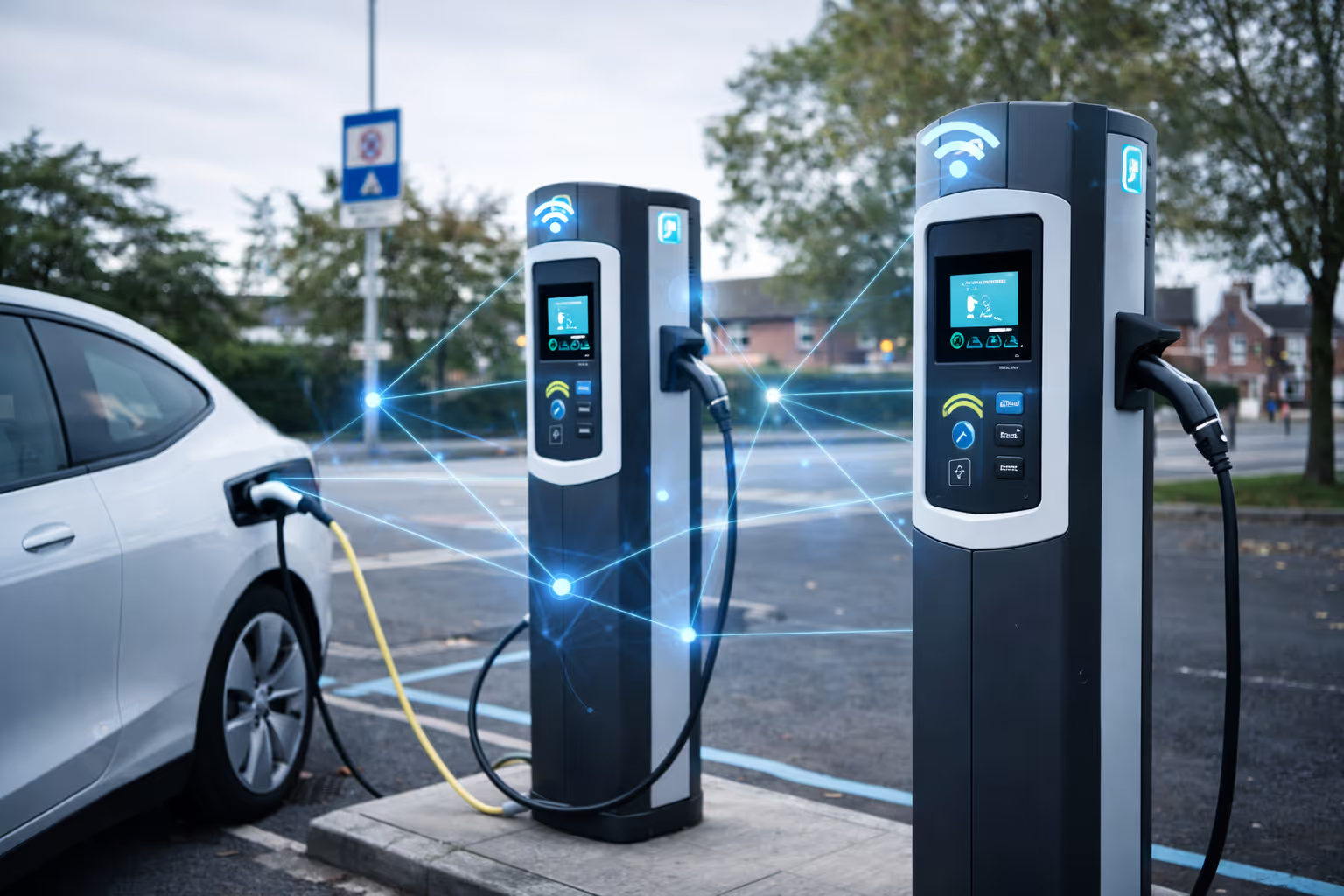
An EV charger is only useful if it is reachable. A multi-network IoT SIM paired with an industrial cellular router gives the charger controller and payment terminal a resilient backhaul to the OCPP platform, with automatic failover between UK carriers. Secure remote access for diagnostics and firmware updates is delivered via VPN, fixed IP or private APN, depending on the deployment. The result is fewer offline chargers, fewer failed payments and considerably fewer unnecessary site visits.
Why EV Chargers Need Cellular Connectivity
An EV charger is a connected device first and an electrical product second. It has to authenticate users, process payments, report usage in real time, accept remote configuration and respond to OCPP commands from the central management system. If the connection breaks, the charger does not just lose data, it usually stops working altogether. A driver pulls in, taps a card, gets nothing, and drives away with a poor view of the network and the operator.
Most chargers are installed in locations where fixed-line connectivity is unavailable, slow to provision or commercially unviable. Car parks, roadside bays, retail estates, workplaces and rural locations rarely have a wired connection waiting at the cabinet, and the cost of installing one to each charging point is hard to justify against the data volumes actually being carried. Cellular is the practical answer, and at the scale a charging operator deploys, it has to be specified properly: not a consumer SIM in a basic modem, but an industrial setup that survives unattended outdoor operation for years.
Charger sites combine a familiar set of problems. Cellular signal varies significantly with cabinet location and surrounding structures, with metal-clad cabinets, basements and underground car parks the worst offenders. Mobile networks get congested at peak periods exactly when usage is highest. Chargers drop offline silently, with no alert reaching the operator until a customer complains or revenue dips. Failed payment authorisation and incomplete charging sessions are visible to drivers and corrosive to network reputation. And remote access for diagnostics is often limited or insecure, leaving every issue as a potential site visit. As the network grows, each of these turns into recurring operational drag.
How It Works: The Connectivity Stack
A typical EV charging deployment pairs an industrial cellular router with a multi-network IoT SIM, acting as the dedicated communications gateway between the charger controller, payment module and the operator's OCPP platform.
An industrial cellular router is installed inside the charger cabinet or a dedicated comms enclosure, connected via Ethernet to the charger controller and payment terminal. The router accepts a multi-network IoT SIM that automatically attaches to the strongest available UK carrier, removing the single-network risk that comes with a consumer SIM in a location the operator did not choose for signal quality. Dual-SIM failover provides a second layer of resilience: if the primary connection drops or the primary carrier becomes congested, the router switches to a backup SIM on a different network within seconds, before a charging session is interrupted or a payment fails.
For a charging hub of any complexity (multiple chargers, dynamic load balancing across the site, on-cabinet edge logic), the connectivity layer increasingly does more than ferry data to the cloud. It can host containerised services at the edge, coordinate between chargers locally without round-tripping through the OCPP backend, and provide a stable platform for the operator's own software. The right router for that job is more capable than the one needed for a single 22kW workplace charger, and Millbeck specifies hardware that matches what each site actually needs to do.
Data is carried back to the OCPP platform through encrypted VPN tunnels, with the router establishing the connection outbound so no public IP is exposed at the charger. For deployments that need direct remote access into the charger controller for diagnostics or configuration, options include fixed public IP and private APN, the latter keeping operational traffic off the public internet entirely. The right combination depends on the asset value, the OCPP platform in use and the operator's security model, and Millbeck can configure any of them on the same connectivity stack.
We supply the full connectivity stack in one place: multi-network IoT SIMs with VPN, fixed IP and private APN options, industrial routers from Teltonika and Proroute pre-configured to the correct APN, and high-gain antennas from brands like Panorama suited to outdoor cabinet installs where signal can be marginal. Established 5G platforms like the Teltonika RUTX50 cover most charger deployments cleanly, and the more capable Teltonika RUTC50 with Docker container support and the Teltonika C platform suits charging hubs running edge logic or on-site coordination. No separate SIM provider, hardware vendor and antenna supplier to coordinate. One partner, one support desk, fully tested before dispatch.
Key Connectivity Requirements
Six things separate an EV charging connectivity setup that scales cleanly across a national network from one that costs the operator a truck roll every time a network has a bad day.
Why Basic Connectivity Is Not Enough
Many early EV charging deployments rely on consumer SIMs and basic cellular modems. At a few chargers that may be tolerable. At a national network it becomes a permanent operational drag.
The failure modes are predictable. Single-network SIMs cannot recover from local outages or peak-time congestion, and there is no second carrier to fail over to when the first one degrades. There is no proactive monitoring of signal quality or connection stability, so problems are only spotted when a driver complains or revenue drops. Public IP exposure on chargers increases the security surface unnecessarily on assets that need to last a decade. And manual site visits for fault diagnosis and recovery are the most expensive failure mode in a sector where the chargers are dispersed by definition.
As charging estates grow, these limitations turn into real cost. Specifying the connectivity layer properly at the outset removes most of the truck rolls, downtime and reputational damage that comes with chargers that quietly stop working.
Where This Approach Fits
The same connectivity stack supports the full range of charging deployments, because the underlying problem is the same in each: continuous, secure OCPP and payment data from a charger in a location that does not have wired internet on offer.
Public EV charging networks use it as the primary backhaul across geographically dispersed sites, with the same connectivity model applied consistently from urban car parks to rural roadside bays. Workplace and destination chargers use it where corporate IT will not extend the building network out to the car park, or where the operator wants the chargers to be independent of the host site's IT entirely. Rapid and ultra-rapid charging hubs benefit from the failover behaviour and edge-capable hardware, given the customer expectation and revenue stakes are higher. Rural and roadside installations rely on cellular as the only practical option. Temporary or rapidly deployed charging sites, including event power and pop-up installations, use the same kit specified for short-term operation.
In every case the requirement is the same: continuous, secure, low-touch connectivity that an operations team can rely on without sending an engineer every time a charger stops responding.
Why Work With Millbeck
We are not a generic telecoms reseller. We specialise in IoT and M2M connectivity for industrial hardware: routers, gateways, antennas and the SIMs that power them. Since 2002 we have been pairing cellular hardware with the right connectivity for the job. Our team configures the APN, tests the SIM in the router, advises on antenna selection for outdoor cabinet installs where signal can be marginal, and provides UK-based support when you need it. Whether you are commissioning a single workplace charger or rolling out across a national charging network, we handle the full stack so your operations team or charging integrator can focus on what they do best.
Frequently Asked Questions
What kind of SIM do I need for an EV charger?
A multi-network IoT SIM, not a consumer mobile SIM. Multi-network roaming is what keeps the charger online when one carrier has weak coverage at the location, because the SIM attaches automatically to whichever UK network is strongest. The SIM should also be provisioned with the right remote access option for the deployment: a VPN tunnel for most installs, a fixed public IP where the OCPP platform needs direct routability, or a private APN where charger traffic must stay off the public internet entirely. A consumer mobile SIM offers none of this and is the wrong fit for a critical, unattended public asset.
How much data does an EV charger use each month?
OCPP traffic, payment transactions and routine telemetry are generally low-bandwidth, often under a gigabyte per month per charger. Sites with video monitoring, customer-facing screens, more frequent diagnostic uploads or edge analytics can use considerably more. We help operators specify the right SIM plan based on the actual workload, and the Millbeck SIM portal provides per-SIM usage alerts and spend caps so a misconfigured charger does not produce a surprise bill across the estate.
Do I need 5G for an EV charger, or is 4G LTE enough?
Most EV charging deployments run comfortably on 4G LTE. The data volumes are usually modest and latency requirements are not extreme. 5G becomes worthwhile in dense urban locations where 4G is congested at peak times, in higher-end charging hubs running edge logic or richer telemetry, or where the operator wants to future-proof the install. Specifying a 5G-capable router gives the site a working 4G connection today and a clear path to 5G as coverage expands.
How is the charger kept secure?
Through a combination of network-layer and device-layer controls. At the network layer, the standard model is an outbound VPN tunnel from the charger router to the OCPP platform, with no inbound public IP exposed at the charger. For deployments that need direct remote access, fixed public IP combined with firewall rules, or a private APN that keeps traffic off the public internet entirely, are both available. At the device layer, routers should be configured with strong credentials, restricted management interfaces and IMEI lock on the SIM so it cannot be moved to another device.
What happens if the network drops out at a charger?
Two things, designed in. First, dual-SIM failover at the router switches to a backup SIM on a different network within seconds, so a single-carrier outage or congestion event does not take the charger offline or interrupt an active session. Second, remote management at the operator end alerts the team that the charger has switched SIMs or, in a worst case, gone dark, so the issue is visible immediately rather than discovered when a driver complains or daily revenue is reconciled.
Can the same connectivity stack support edge logic and on-site charger coordination?
Yes, where the deployment needs it. For straightforward single-charger installs, a standard industrial router carries OCPP and payment traffic to the cloud and that is sufficient. For charging hubs with multiple units, dynamic load balancing or on-cabinet logic, more capable routers can host containerised services at the edge and coordinate between chargers locally without round-tripping every decision through the OCPP backend. Millbeck specifies the appropriate hardware based on what each site actually needs to do.



.avif)

