Subscribe to newsletter
Underground Car Park Connectivity: External 5G with Ethernet and Wi-Fi Distribution Underground
How to deliver reliable internet access to payment terminals, ANPR cameras and barrier controllers in underground and enclosed car parks, by separating cellular signal acquisition from internal distribution.
Concrete and steel kill cellular signal underground. The reliable answer is to put the cellular router outside the structure where signal is strong, run Ethernet down into the car park, and distribute connectivity to payment terminals, ANPR cameras and barrier controllers via internal Ethernet and Wi-Fi. This delivers a stable, always-on link to a critical revenue-generating system, with none of the dropouts and reconnect loops that plague routers placed underground.
Why Underground Car Parks Are Hard to Connect
Underground and enclosed car parks are some of the worst environments for cellular connectivity in the built environment. Reinforced concrete, steel mesh, retaining walls and below-ground positioning combine to attenuate mobile signal to the point where it is unreliable or absent. Yet the parking systems inside increasingly depend on continuous internet access: pay-and-display machines, contactless payment terminals, ANPR cameras, barrier controllers and back-office management systems all need to be online to function.
When connectivity fails, the operational impact is immediate. Payments cannot complete. Barriers cannot validate against ANPR. Drivers queue or tail-gate. Revenue is lost on the day, and reputation is damaged for longer than that. Fixed-line broadband is rarely a quick or affordable fix in these environments, with civils, lead times and host-site negotiations turning a simple connectivity requirement into a multi-month project. There is a better approach, and it does not involve forcing a cellular router into a location where cellular cannot perform.
Underground car parks combine a familiar set of problems. Mobile signal does not reliably reach below ground, regardless of which carrier you try. Fixed broadband is unavailable, expensive or slow to provision in most locations. The parking infrastructure (payment terminals, ANPR, barriers, management systems) needs continuous connectivity to function. And those devices are typically spread across large areas over multiple levels, so any solution has to cover meaningful distances inside the structure as well as bring the signal in from outside.
Why Putting a Cellular Router Inside Does Not Work
The intuitive solution is to install a cellular router inside the car park and add an external antenna. In practice, this rarely produces a reliable result.
Signal levels at the antenna position are usually too weak or too unstable, even with a high-gain external antenna mounted at the entrance ramp or service riser. Heavy concrete and steel attenuate any cable run between an antenna and a router placed underground, and the antenna itself often cannot find a position where signal is consistently usable. The router connects, drops, reconnects and drops again. Performance fluctuates unpredictably. Sessions break in the middle of a payment. Site visits and support calls accumulate. Eventually the operator either accepts unreliable service or starts looking for a different approach.
The different approach is to stop trying to bring cellular into the car park at all, and instead bring Ethernet in from a router placed where cellular actually works.
The Architecture: External Cellular, Internal Distribution
Three steps, one principle: keep the cellular connection where signal is strongest, and use wired networking and Wi-Fi for everything underground.
Outdoor 4G or 5G Router
An outdoor cellular router is installed outside the underground structure, in a location with strong, stable signal. Typical mounting positions include a building roof, an external wall at street level, or a service riser or lighting column above the car park. The router carries the WAN connection over cellular, unaffected by the signal loss inside the structure.
Long-Run Ethernet Backhaul
A single Ethernet cable runs from the outdoor router down into the car park, terminating at the internal network point. Cable runs of up to 80 metres sit comfortably within standard Ethernet limits, providing stable, interference-free backhaul with predictable latency and throughput. PoE delivers power to the outdoor unit over the same cable. No repeat cellular devices underground, no signal-dependent links inside the structure.
Internal Switch and Wi-Fi Distribution
Inside the car park, the Ethernet feed terminates at a local switch or internal router. From there, connectivity reaches payment terminals, ANPR cameras and barrier controllers via wired Ethernet, and Wi-Fi access points cover any devices that cannot be cabled or that sit across multiple parking levels. The internal network is wired-first wherever possible, with Wi-Fi filling the gaps.
Two Ways to Build the Outdoor Unit
There is more than one way to put a cellular router outdoors. Both approaches work, and the right choice depends on the install location, the performance requirement and what is already on the operator's hardware standard.
The first option is a purpose-built outdoor router. Devices like the Teltonika OTD500 and Teltonika OTD144 are IP-rated for external mounting, with integrated antennas, PoE input and weatherproof housings. They go straight on a wall, mast or lighting column and need only an Ethernet run back to the building. This is the simplest option to install and maintain, and it works well where the install position is a clean external mounting point and the operator wants a single self-contained outdoor unit.
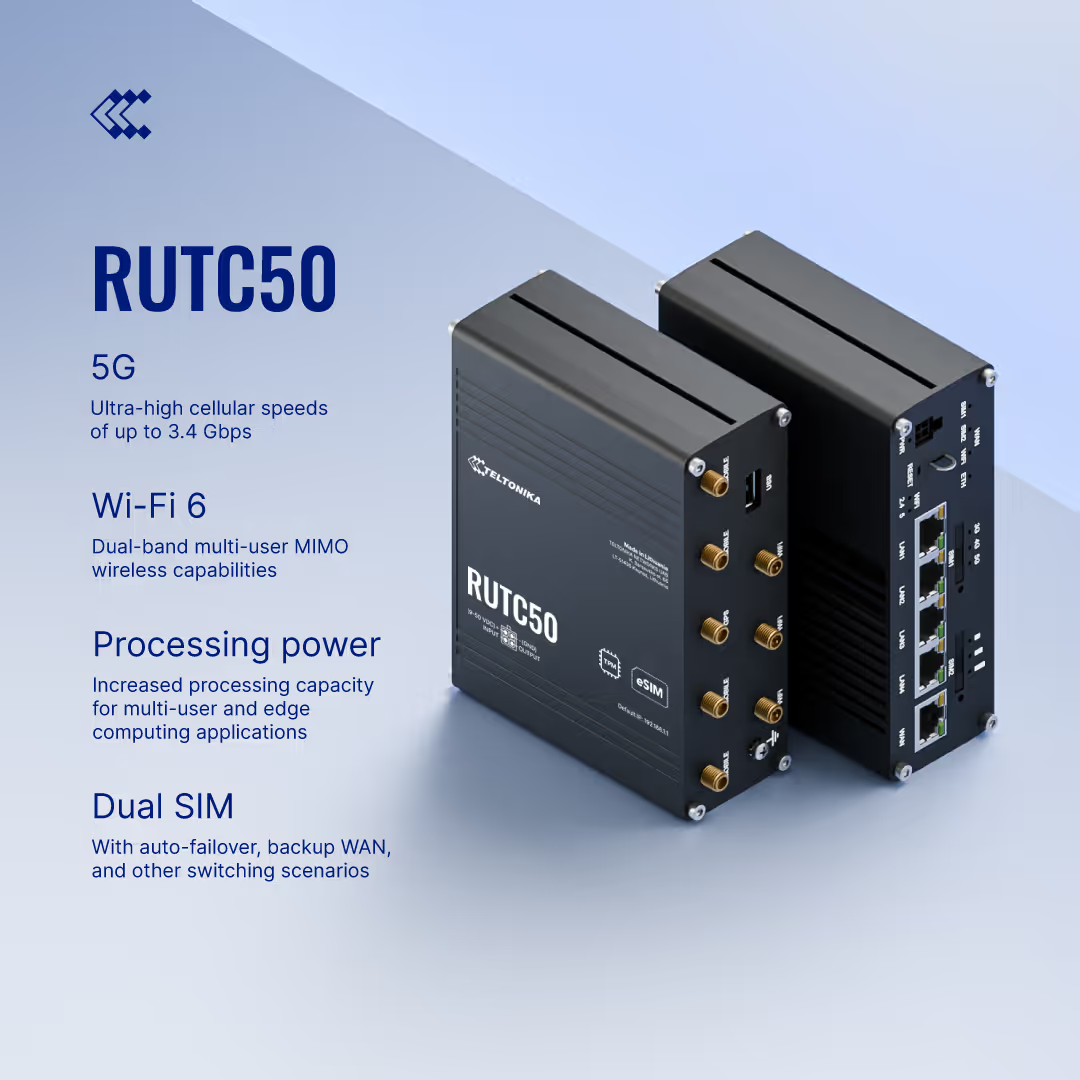
The second option is to take a more powerful indoor router (a Teltonika RUTX50 or RUTC50) and house it inside an outdoor antenna enclosure from QuWireless. The QuWireless QuSpot enclosures are weatherproof housings with integrated 4G or 5G MIMO antennas, designed specifically to hold a Teltonika router inside. The result is a single outdoor unit that combines the higher performance and feature set of the indoor router (5G, dual-SIM, more I/O, in the case of the RUTC50 the Teltonika C platform with Docker support) with the IP-rated mounting and antennas of the QuWireless housing. This is the right choice where the install needs more performance, edge logic or richer telemetry than a purpose-built outdoor router provides.
We supply the full connectivity stack in one place: multi-network IoT SIMs with VPN, fixed IP and private APN options, the right outdoor unit for the install (purpose-built outdoor router or indoor router in a QuWireless enclosure), the Ethernet and PoE kit to bring it underground, and the internal switching and Wi-Fi to distribute connectivity across the car park. No separate SIM provider, hardware vendor and antenna supplier to coordinate. One partner, one support desk, fully tested before dispatch.
Key Connectivity Requirements
Six things separate a car park connectivity setup that runs reliably for years from one that creates support tickets every time a host site fills up or a network has a bad day.
Where This Approach Fits
The same architecture supports a range of underground and enclosed parking environments, because the underlying problem is the same in each: cellular signal does not reach the equipment, but Ethernet and Wi-Fi do.
Underground car parks in city centres are the textbook case, with deep below-ground levels and dense surrounding structures. Multi-storey enclosed parking benefits even where the structure is partly above ground, because the lower levels are still effectively shielded. Retail and commercial parking facilities use the approach to bring connectivity to payment islands and ANPR cameras spread across large sites. Residential and mixed-use developments use it to give residents and visitors a working barrier and payment system without exposing the parking infrastructure to the building's IT network. Temporary or retrofit parking installations, including event car parks and pop-up arrangements, use it where wired connectivity simply is not available on the timescale needed.
In every case the principle is the same: signal acquisition outside, distribution inside, and a single stable cellular link doing the work that consumer-grade approaches struggle to deliver.
Key Design Considerations
A reliable install starts with a few practical decisions about where the outdoor unit sits and how the underground network is laid out.
Start with the outdoor router position. It needs strong, stable signal (which usually means roof or upper-storey wall level), secure mounting that survives weather and any access risk, and a clean Ethernet run down into the building. Then plan the cable route: standard Cat5e or Cat6 will carry both data and PoE power up to 80 metres without issue, and protected cable trays or conduit keep the run safe through plant rooms and risers. Inside the car park, plan Wi-Fi access point placement against the actual device positions, accounting for column dead zones and the way signal behaves around concrete pillars. Finally, segment the network properly: payment systems on one VLAN, public Wi-Fi (if offered) on another, and management traffic isolated from both. None of this is exotic, but each step is where a sloppy install creates an unreliable system.
Why Work With Millbeck
We are not a generic telecoms reseller. We specialise in IoT and M2M connectivity for industrial hardware: routers, gateways, antennas and the SIMs that power them. Since 2002 we have been pairing cellular hardware with the right connectivity for the job. Our team configures the APN, tests the SIM in the router, advises on whether a purpose-built outdoor router or an indoor router in a QuWireless enclosure is the right call for the site, and provides UK-based support when you need it. Whether you are connecting a single retail car park or rolling out across a portfolio of underground sites, we handle the full stack so your installer or facilities team can focus on the install rather than on troubleshooting cellular.
Frequently Asked Questions
Why not just use a high-gain antenna inside the car park?
Because the underlying problem is structural, not antenna-related. Reinforced concrete and steel attenuate cellular signal so heavily that even a high-gain antenna mounted at the entrance ramp or service riser usually cannot maintain a stable link to a router placed underground. The signal at the antenna position is the bottleneck, not the cable run. Putting the router outside, where the signal is strong in the first place, removes the bottleneck rather than working around it.
How far can the Ethernet cable run from the outdoor router into the car park?
Standard Ethernet (Cat5e or Cat6) supports cable runs of up to 100 metres, with 80 metres a sensible practical maximum once cable bends and termination losses are accounted for. PoE travels over the same cable to power the outdoor unit. For runs longer than 80 metres, options include fibre with media converters, or an intermediate switch placed in a service corridor to extend the network.
Should I use a purpose-built outdoor router or an indoor router in a QuWireless enclosure?
It depends on the install. A purpose-built outdoor unit (like the Teltonika OTD501 or OTD144) is the simplest option: IP-rated, integrated antennas, PoE-powered, designed to bolt straight to a wall or column. An indoor router (like the RUTX50 or RUTC50) inside a QuWireless QuSpot enclosure delivers more performance and a richer feature set, including 5G, dual-SIM with full failover, more I/O, and on the RUTC50 the Teltonika C platform with Docker support. Use a purpose-built outdoor router for straightforward installs and the indoor-in-enclosure approach where the site needs more capability or where edge logic and on-cabinet services are part of the picture.
What kind of SIM should the outdoor router use?
A multi-network IoT SIM, not a consumer mobile SIM. Multi-network roaming is what keeps the link online when one carrier has weak coverage at the outdoor mounting position, because the SIM attaches automatically to whichever UK network is strongest. The SIM should also be provisioned with the right remote access option for the deployment: a VPN tunnel for most installs, a fixed public IP where the parking management platform needs direct routability, or a private APN where payment and ANPR traffic must stay off the public internet entirely.
How is the parking system kept secure across cellular and underground Wi-Fi?
Through a combination of network-layer and device-layer controls. At the network layer, the outdoor router uses outbound VPN to reach the management platform, with no inbound public IP exposed. Internally, payment systems sit on a separate VLAN from any public Wi-Fi or guest traffic, with firewall rules restricting which devices can talk to which. At the device layer, both the outdoor router and the internal switch should be configured with strong credentials and restricted management interfaces, and the SIM should have IMEI lock applied so it cannot be moved to another device.
Can the same setup support public Wi-Fi for drivers as well as payment systems?
Yes, where the operator wants to offer it. The internal switch and Wi-Fi APs can broadcast a separate public SSID on its own VLAN, isolated from payment, ANPR and management traffic. The cellular link upstream has to have enough headroom to support both, which is one of the reasons 5G or a higher-capacity router is worth specifying when public Wi-Fi is part of the requirement. The Millbeck SIM portal provides per-SIM usage alerts so a sudden spike in public Wi-Fi traffic is visible before it becomes a billing event.