Teltonika has added WANplex, its own WAN bonding service, to RutOS and RMS. It combines up to four internet connections on one router into a single link, so a site keeps working when any one of them fails.
WANplex first appeared in the RutOS 7.26.1 firmware. Teltonika said on its community forum on 3 November 2026 that the full release, including documentation, was planned for later in the month, and the RMS documentation is now published.
At Millbeck, we supply Teltonika routers and multi-network IoT SIMs for sites that cannot afford to go offline. This article explains what WANplex does, how it differs from failover, and what to plan before you use it.
What Is Teltonika WANplex?
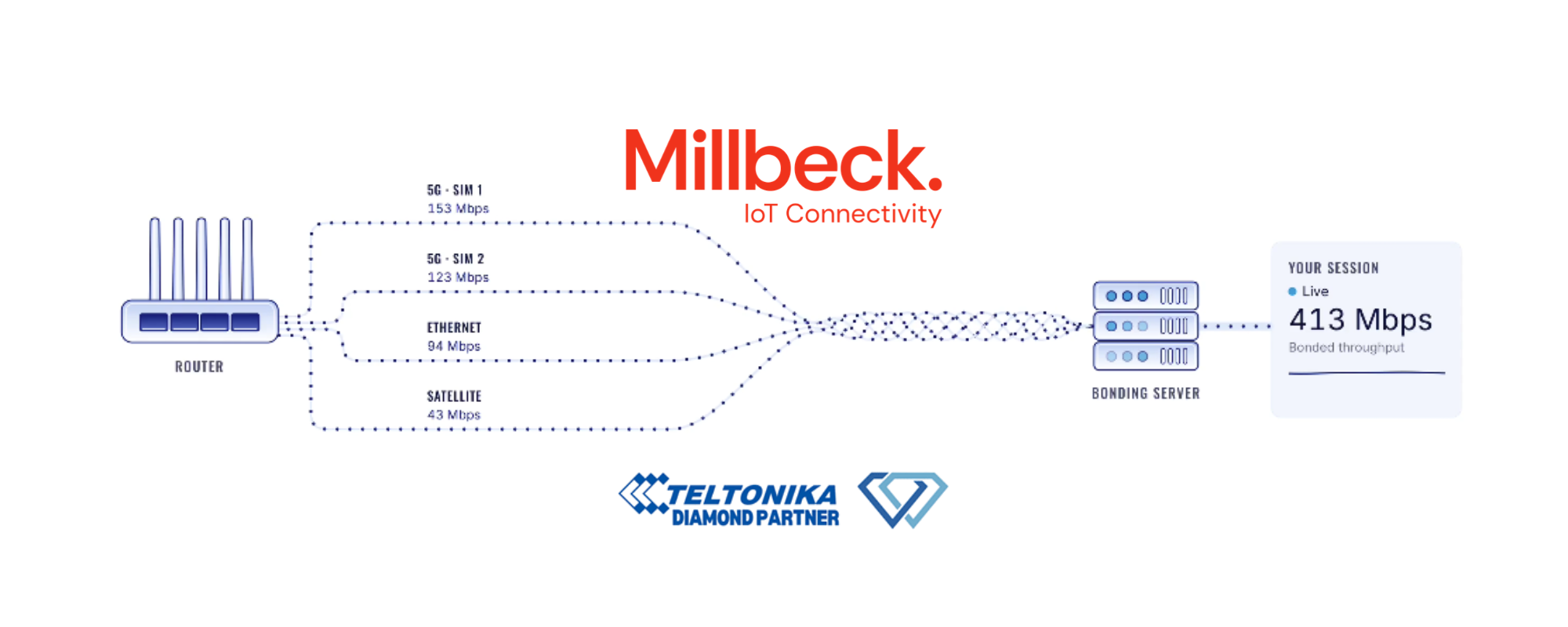
Teltonika WANplex is a WAN bonding service that combines several internet connections on a Teltonika router into one logical link.
The connections can be mobile, Ethernet WAN or Wi-Fi WAN, and each router can bond up to four of them. All of the bonded links carry traffic at the same time. If one link slows down or drops, traffic carries on over the links that remain.
WANplex is set up and licensed through Teltonika RMS, the remote management platform. The router sends its traffic across the bonded links to a WANplex hub, which is a server that you or your integrator host. The hub joins the traffic back together and passes it on.
How Is Bonding Different From Failover and Load Balancing?
Bonding uses every connection at once for the same traffic, while failover keeps a backup link waiting and load balancing gives each session a single link.
| Method | How the Links Are Used | When a Link Fails |
|---|---|---|
| Failover | One link carries the traffic. A backup link waits. | The router switches to the backup, usually within seconds. Sessions in progress can drop and restart. |
| Load balancing | Sessions are shared out across the links. Each session stays on one link. | Sessions on the failed link drop. New sessions use the remaining links. |
| Bonding (WANplex) | All links carry traffic together as one connection. | Traffic continues over the remaining links. |
Failover is still the right choice for many sites. It is simple, it uses mobile data only when the main line is down, and a few seconds of switchover does not matter to most equipment. Bonding suits sites where even a short break causes a problem, or where no single connection is fast enough on its own.
Why Multiple Connections Make a Site More Resilient and More Secure
Multiple connections make a site more resilient because no single line, network or modem can take it offline, and that availability is part of keeping the site secure.
Security is often described in terms of confidentiality, integrity and availability. An outage is an availability failure. A CCTV tower that drops offline is not being watched. An alarm that cannot signal is not protecting anything. A till that cannot authorise payments stops trading. Keeping the connection up is a security measure in its own right.
Resilience comes from links that do not share the same weak point. Two SIMs on the same mobile network can fail together when that network has a fault. The strongest designs mix connection types and networks:
- Different networks. Our UK roaming IoT SIMs have unsteered access to EE, O2, Vodafone and Three, so each cellular link has more than one network to use.
- Different hardware paths. Dual modem routers such as the RUTM52 and RUTC42 run two independent cellular modems, so a fault on one does not stop the other.
- Different connection types. A fixed line bonded with one or two cellular links protects against a cut cable as well as a mobile network fault.
Bonding Is Not Encryption
Bonding protects availability. It does not replace network security. We recommend keeping the controls you already rely on, such as a private APN, fixed private IP addresses and VPN tunnels. Our IoT SIM security page explains how these layers work together.
What Do You Need to Run WANplex?
To run WANplex you need a supported Teltonika router, an RMS account, a hub server and a WANplex licence for each router.
- A supported router. Teltonika lists the RUTX, RUTM and RUTC families, running RutOS 07.26.1 or newer. The RUTX series is now End of Life, so we recommend RUTM or RUTC models for new projects.
- More than one live connection. A router with one modem can bond its cellular link with a wired or Wi-Fi WAN. To bond two cellular links at the same time, choose a dual modem router.
- Teltonika RMS. You create the hub in RMS, add your routers to it, and choose up to four interfaces on each router to bond.
- A hub server. The hub runs on a Linux server with Docker. Teltonika recommends a processor with 4 cores and 8 threads, 16 GB of RAM and a 1 Gigabit network port. Each router can be pointed at a primary or a secondary server.
- A licence for each router. WANplex is licensed through RMS credits. Speak to us for current pricing.
What Should You Plan Before You Bond?
Before you bond connections, plan for higher mobile data use, real network diversity, and a hub server that someone looks after.
- Mobile data use goes up. A failover SIM carries data only during an outage. A bonded SIM carries a share of the traffic all day. Size the data allowance for that, and ask us about tariffs that suit it.
- Diversity has to be designed in. Bonding several links that depend on the same network or the same mast adds speed but little protection. We can advise on SIM and antenna choices for each site.
- The hub is a shared dependency. Every bonded site relies on the hub. It needs patching, monitoring and a secondary server, in the same way as any other piece of core infrastructure.
- Test it under real conditions. Unplug a link while the application is running and watch what happens. A resilience design is only proven once it has been tested.
Ben Finder, Technical Director, Millbeck
'Failover has always been about getting a site back online quickly. Bonding goes a step further, because the site does not go offline in the first place. Having it built into RutOS and managed in RMS makes it far easier to roll out across an estate. The hardware is only half of it, though. The links you bond need to be different enough that one fault cannot take them all down.'
Frequently Asked Questions
Which Teltonika Routers Support WANplex?
Teltonika's RMS documentation lists the RUTX, RUTM and RUTC router families as supporting WANplex, running RutOS 07.26.1 or newer. Other Teltonika ranges are not listed. The RUTX series is End of Life, so RUTM and RUTC models are the better choice for new deployments.
Does WANplex Replace Failover?
WANplex does not replace failover. Failover remains a simple and low-cost way to keep a site online, because the backup link carries data only during an outage. WANplex suits sites where a short break in service is not acceptable, or where one connection alone is not fast enough.
How Many Connections Can WANplex Bond?
WANplex can bond up to four interfaces on each router. Teltonika's documentation gives mobile, Ethernet WAN and Wi-Fi WAN connections as examples. The number you can use in practice depends on the router model and how many live connections it has.
Do I Need a Server to Use WANplex?
WANplex needs a hub server. The hub is software from Teltonika that runs on a Linux server with Docker, hosted by you or your integrator. RMS provides the installer, and each router can be given a primary and a secondary server.
Does WANplex Use More Mobile Data Than Failover?
WANplex uses more mobile data than failover on most sites. With failover, the cellular link carries data only when the main connection is down. With bonding, every link carries a share of the traffic all the time, so each SIM needs a data allowance to match.
Does WANplex Make a Connection Faster?
WANplex can make a connection faster, because Teltonika describes the service as improving throughput as well as resilience. The result depends on the speed of each link, the router and the hub server, so we recommend testing on your own site before relying on a figure.
Talk to Millbeck About Bonded and Failover Connectivity
Millbeck is a Teltonika Diamond distributor and IoT SIM provider based in Leeds, UK. We can help you choose between failover and bonding, specify the Teltonika router, and supply multi-network IoT SIMs sized for the data each link will carry. You will speak directly to people who know the technology.
Speak to us about your projectMillbeck. IoT Connectivity